
How to Become a Sports Nutritionist and Salary Outlook
Are you a dietitian looking to break into the exciting field of sports nutrition? Whether you're fascinated by how nutrition can enhance athletic performance or want to work with top athletes, becoming a sports dietitian nutritionist can be a rewarding career move.
This guide walks you through everything you need to know, including where sports dietitians work, salary expectations, certifications to bolster your expertise, and the resources to set you on a path to success. Let's explore how you can pivot your career toward the world of sports nutrition.
Up First: What Does it Take to Become a Dietitian?
To become a dietitian, you'll first need to complete the required education and training. This includes earning a bachelor's degree in dietetics, nutrition, or a related field, completing a supervised practice program, and passing the Registered Dietitian Nutritionist (RDN) exam.
If you’re still exploring how to become a dietitian, check out this detailed guide! Once you’ve earned your credentials, you’ll be equipped with the foundational knowledge to branch into specialized areas like sports nutrition.
Why Focus on Sports Nutrition?
Sports nutrition is a dynamic field that blends nutrition science with a passion for physical performance. Dietitians in this niche work closely with athletes to develop nutrition plans that help improve endurance, build muscle, and optimize performance.
This specialization isn't just about helping professional athletes hydrate or recover after games—it applies to recreational athletes, high school and college sports teams, and even emerging fitness communities. The variety of opportunities in sports nutrition means you can align this career with your specific interests and expertise.
Angie Dye, a Registered Dietitian Nutritionist (RDN), Certified Specialist in Sports Dietetics (CSSD), and founder of Carpe Diem Nutrition, offers this encouragement:
“Registered Dietitians are uniquely qualified to interpret and translate cutting-edge research into practical fueling strategies that can safely support the athletes in our care. Our backgrounds in human nutrition and metabolism, combined with our extensive training in counseling and motivational interviewing, position us to be the most qualified professionals to support athletes across every discipline.”
A Sports Nutritionist or a Sports Dietitian is a specialty niche which provides nutrition advice and guidance to athletes focusing on optimizing their performance and enhancing their exercise recovery.
A job as a sports nutritionist or sports dietitian is a booming field. Both consumers and the sports industry are looking for qualified nutrition experts.
As the field of sports performance increases and the appreciation for fueling the body improves, so do job opportunities for nutrition professionals. Fueling exercise performance and recovery with specialized nutrition and diet (macronutrient and micronutrient intake) is nuanced, which makes for an in-demand job opportunity for dietitians.
What does a sports nutritionist do?
Sports dietitians find roles in diverse settings based on their interests and target clientele. Here are some Common Workplaces for Sports Dietitians:
- Professional Sports Teams – Work directly with players to optimize nutrition strategies during games, practices, and recovery periods.
- Collegiate Athletic Programs – Provide nutrition advice and meal planning for student-athletes balancing academics and demanding training schedules.
- Sports and Fitness Centers – Develop nutrition programs tailored to the needs of members or specific fitness goals.
- Corporate Wellness Programs – Partner with organizations to improve employee fitness and nutrition, often catering to competitive recreational athletes.
- Private Practice or Consulting – Offer one-on-one coaching to clients, from triathletes to weekend warriors aiming to up their game. We have much more information on launching a private practice in this article: How to Become a Private Practice Dietitian.
Jena Brown, RD, CSSD, sports dietitian and owner of Victorem Performance Nutrition in Brenham, Texas, busts a common myth about sports dietitians:
“Sports nutrition principles are not limited to the traditional athlete persona. Active individuals seeking overall health, wellness, and progress with an exercise routine can benefit from sports nutrition programming. Sports nutrition settings exist beyond collegiate and institutional settings. Private practice, consulting, and media are non-traditional opportunities for specialization in sports nutrition.”
The key takeaway? The sky’s the limit for the kinds of work you can do to support active people!
P.S. If a virtual private practice sounds like an exciting route to you, the world of telehealth continues to grow! Check out our round-up of telehealth opportunities; there are several options to have support with growing a private practice in a niche of your choosing, including sports nutrition: Telehealth Opportunities for Dietitians: Your Guide.
Sports Nutritionist Job Description
The sports dietitian provides individual and group/team nutrition counseling, nutrition plans, and education on-site (team home base) or when traveling.
According to the Commission on Dietetic Registration (CDR), the Sports Dietetics practice experience that qualifies includes:
The sports dietitian provides individual and group/team nutrition counseling and education to enhance the performance of competitive and recreational athletes. Primary responsibilities include counseling individuals and groups on daily nutrition performance and health; translating the latest scientific evidence into practical sports nutrition recommendations; tracking and documenting outcomes of nutrition services, serving as a food and nutrition resource for coaches, sports performance, support staff and families. This is accomplished by providing sports nutrition education for health/wellness programs, athletic teams, and community groups; and maintaining professional competency and skills required for professional practice, or indirectly as documented by management, education, or research practice linked specifically to sports dietetics.
Understanding the necessary grams of carbohydrates, proteins, and fats needed to fuel specific sports and types of activity is part of the job. Providing recommendations to the athletes that include which foods have these specific macronutrients and in what quantities they are needed and at what times is also vital for one’s strength, endurance, and optimal recovery. In addition, knowing how much fluid should be consumed is important, too. The job of a Sports Nutritionist and a Sports Dietitian can be very complicated and requires specific training and education.
The Dietetic Practice Group of the American Academy of Nutrition and Dietetics, called Sports, Cardiovascular and Wellness Nutrition (SCAN), has a comprehensive Sports Dietitian job description that is helpful.
In general, a Sports Nutritionist or Sports Dietitian performs the following, according to SCAN:
- Assesses and analyzes dietary practices, body composition, and energy balance (intake and expenditure) of athletes in the context of athletic performance and health.
- Counsels athletes on optimal nutrition for exercise training (match nutrition to training phases and goals), competition, recovery from exercise, weight management, hydration, immunity, disordered eating, travel, and supplementation.
- Counsels professional athletes, recreational athletes, and athletes in general, on achieving and maintaining a level of body mass, body fat, and muscle mass that is consistent with good health and good performance.
- Provides personalized meal plans and snack plans to promote achieving short- and long-term goals for athletic performance and good health.
- Develops and counsels in hydration protocols.
- Addresses nutritional challenges to performance, such as food allergies, bone mineral disturbances, gastrointestinal disturbances, iron depletion, and iron-deficiency anemia.
- Provides medical nutrition therapy, as needed, to help manage or treat medical conditions.
- Counsels athletes on optimal nutrition for recovery from illness or injury.
- Coordinates nutritional care as a member of multidisciplinary sports medical/sports science teams.
- Provides liaison with in- and out-patient programs for conditions such as disordered eating.
- Evaluates nutritional supplements, including herbal supplements, for legality, safety, quality, and efficacy; monitors use of appropriate supplementation.
- Collaborates with the individual’s family, physician, coach, and other health professionals, as appropriate.
- Develops resources to support educational efforts.
- Educates in food selection (grocery store tours, food storage) and food preparation (cooking classes).
- Documents nutrition services provided and evaluates the effectiveness of nutrition strategies towards meeting desired outcomes using the Nutrition Care Process.
- Educates and mentors dietetic interns and others as appropriate.
- Supervises DTRs, student workers, and employees.
- Develops and oversees nutrition policies and procedures.
Day in the life of a Sports Dietitian (or week in the life)
Have you ever been curious about how sports dietitians spend their day? Here's a real week-in-the-life of a sports dietitian at a well-known college lacrosse team:
1. Developing hydration protocols to deal with the chronic crampers
2. Pre-game meal options
3. Develop half-time nutrition strategies
4. Create supplement protocols
5. Develop an on-campus fueling station
6. Implement travel nutrition guidelines
7. Add an Omega 3 supplement protocol for concussion management
8. How to address the over consumption of energy drinks
Sample Sports Dietitian Job Description
There are oh-so-many careers involving fitness and nutrition. Here’s an example of what a sports dietitian job posting might look like:
Position: Sports Dietitian – Professional Soccer Team
Responsibilities:
- Develop individualized performance-focused meal plans for players.
- Conduct hydration testing and provide recommendations tailored to climate conditions.
- Monitor athletes’ energy needs during competitive seasons.
Qualifications:
- RDN credential required.
- 2+ years of experience in sports nutrition or related fields.
- Board Certification in Sports Dietetics (CSSD) is preferred.
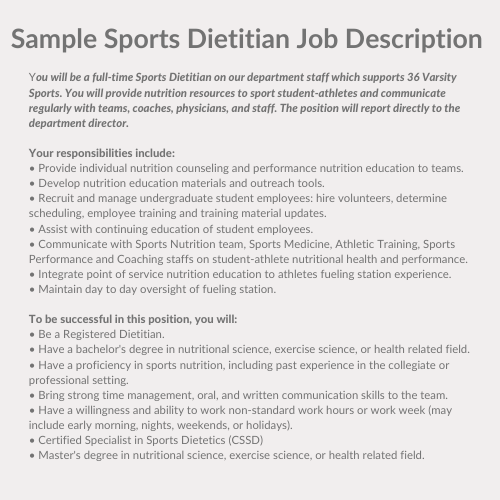
The below sample Sports Dietitian job description is from an actual job posting for the position title of Assistant Sports Dietitian at a large private university.
Getting Started: How to become a sports dietitian
Angie offers this encouragement to get started, even if you’re feeling the pull of imposter syndrome:
“If you feel a calling to help athletes optimize their nutrition to perform their best, a career as a sports dietitian might be a winning career path for you.
But sometimes, having a passion to work with athletes on their nutrition doesn’t feel like quite enough. How can you establish yourself as a trusted expert in the field when it seems dominated by influencers who might not have a degree in anything but their six-pack abs? It’s the same advice that we often give to our athletes, “trust your training.”
There are excellent ways to boost your confidence and establish yourself in the field of sports nutrition. Some of my favorites include:
- seeking out sports nutrition CEUs
- attending sports nutrition conferences
- speaking to local sports teams
- blogging on sports nutrition topics
- collaborating with personal trainers, physical therapists, and other professionals who work closely with athletes
Aside from being educational and fun, most of these experiences can count toward hours for a Certified Specialist in Sports Dietetics certification if that is a long-term goal.
Sports Nutrition Conferences
Attending sports nutrition conferences is a fantastic way to network and stay updated on cutting-edge research. Some top options include:
- Sports Dietitians of Australia (SDA) Annual Conference
- The International Society of Sports Nutrition (ISSN) Conference
Each one offers unique learning opportunities along with the chance to meet industry leaders. While you’re attending conferences, be sure to network! You never know where a connection might lead - here is how: How To Network At A Conference.
Meet the team
As you join your fellow dietitians who are working in the field of sports nutrition, know that you’re in good company! We have shed the spotlight on several dietitians who are involved in sports, and their articles are linked below. Learn what a day in the life of a sports nutritionist is for them!
- Heather Mangieri, Sports and Wellness Dietitian
- Allison Koch, Private Practice Sports Nutritionist
- Chrissy Carroll, Triathlon Coach, Blogger
Generally, there are basic requirements and degrees needed to call oneself a Sports Nutritionist or Sports Dietitian. To be more competitive, add additional professional certifications and join related organizations.
- The Basics for Sports Nutritionists. There are no specific regulations to call oneself a Sports Nutritionist. For example, a few online courses offer a basic sports nutritionist certification after taking just one or two classes. However, these mini-courses do not provide an in-depth knowledge. To gain a better competitive edge, it is recommended to get at least a Bachelor’s degree from an accredited institution in both Nutrition and Exercise Science/Physiology or Kinesiology. Several academic institutions offer joint programs in both nutrition and exercise science which can be more efficient and effective in saving time and money.
- The Basics for Sports Dietitians. Once the undergraduate degree is obtained, one can apply to become a Registered Dietitian Nutritionist (RDN) through the Academy of Nutrition and Dietetics (AND). Here is an article on How to Become a Registered Dietitian Nutritionist. After completing the internship and passing the national exam, the RDN title is obtained. You can then continue on with advanced Sports Dietitian Certifications.
- Advanced Sports Nutritionists and Sports Dietitian Degrees. Getting a Master’s degree and even a PhD in Nutrition, Exercise Science/Physiology, or Kinesiology will provide further knowledge and attract a greater number of employers and employment options. Additional degrees and certifications enhance one’s credibility and professional status.
- Advanced Sports Dietitian Certifications. Once registered as a Registered Dietitian, dietitians also have the opportunity to become a Board Certified Specialist in Sports Dietetics (CSSD) from the Commission on Dietetic Registration (CDR). There are specific eligibility requirements including completing 2,000 hours of sports dietetics practice within a 5-year time period. Once eligible, the dietitian needs to apply to the CDR and take an exam. Upon passing the exam, the CSSD is obtained. This advanced certification is highly recognized by professional and collegiate sports institutions and organizations among others. And some organizations require the CSSD credentials for various positions.
Sports Nutrition or Sports Dietitian Certifications
Which is the best sports nutrition certification? The CSSD! Becoming Board Certified in Sports Dietetics (CSSD) sets you apart in the field and demonstrates your expertise. To qualify, you'll need:
- A current RDN certification.
- A minimum of 2,000 hours of documented sports nutrition experience.
- To pass the CSSD exam.
There are many other options for certifications in sports nutrition, but the CSSD is considered to be the gold standard. For more info on how to apply, click here: CSSD Eligibility Requirements.
Board Certified Specialist in Sports Dietetics (CSSD)
This is really the gold standard for Registered Dietitians wanting to work with athletes and demonstrating their expertise. The eligibility for the specialist certification in sports dietetics is listed here:
- Registered Dietitians (RD) with a minimum of two years professional practice experience
- RDs who have demonstrated career experience in sports dietetics practice
- Specialists in sports nutrition qualified to deliver medical nutrition therapy
- National Board Certification by the Commission on Dietetic Registration as a Certified Specialist in
Sports Dietetics (CSSD) - Licensed as per state regulations
Tips for taking the CSSD exam
- Practice finding the exam location ahead of the actual exam
- Eat a solid meal before the exam
- Bring 2 calculators
- If you didn't pass the 1st time around you can take again later!
ACE Fitness Nutrition Specialist
- According to the American Council on Exercise (ACE), "The ACE Fitness Nutrition Specialist Program is designed for health and fitness professionals who want to gain a deeper understanding of nutrition, learn how to help clients implement healthy food choices into their daily routine and understand how to address special nutritional needs for different types of clients, from those simply looking to get healthier to competitive athletes. You'll learn how to guide clients in selecting fresh, nutrient-dense foods, and couple this knowledge with behavior change strategies that will help your clients turn smart choices into long-term habits."
- Become a Fitness Nutrition Specialist
Salaries for Sports Nutritionists and Sports Dietitians
One of the most common questions for aspiring sports RDs is, "How much does a sports nutritionist make?" While a sports dietitian's salary depends on factors like experience, location, and employment type, here's a general breakdown, according to the 2024 Compensation and Benefits Survey of the Dietetics Profession from the Academy of Nutrition and Dietetics:
- Entry-Level Sports Dietitian – $62,700 to $70,300 annually
- Mid-Level Sports Dietitian – $100,300 to $130,300 annually
- Senior RD or Consultant for Pro Teams – $130,300 to $211,800 annually
Freelancers and consultants may have additional earning potential based on their client load and reputation in the industry.
Types of Jobs for Sports Nutritionists and Sports Dietitians
Here are some of the most common places that would hire a Sports Nutritionist or Sports Dietitians or where you could create a job in the field:
- Colleges and universities
- High school teams
- Athletic departments at teaching facilities
- Professional and regular sports organizations
- Competitive athletes
- Athletic clubs and gyms
- Food corporations including sports nutrition products
- Rehabilitation centers
- Research
- Private practice and coaching
- Consulting, brand spokesperson, and media/social media
- Writing/authors
- Content creation
How to Find a Job as a Sports Nutritionist or Sports Dietitian
Finding a job as a Sports Nutritionist Sports Dietitian has similar guidelines as finding a job within any industry or specific field.
- Network. Network. Network. Like all areas of life, who you know matters. The more people you know who are aware that you are looking for a job will keep you updated if/when a job opens up in your area of choice. In addition, if you know people already working in the company, organization, or area you would like to work in, you will have a better chance of getting the job through the referral.
- Social Media - Use social media platforms such as LinkedIn to find a job and network. These platforms have recruiters and hiring managers constantly on them looking for the best fit to fill the open positions. Social media platforms are also great avenues to meet more people within the industry and/or organization, company, or institution you would like to work with.
- Job Alerts - Sign up for notifications on job search websites like NutritionJobs to get notified when new jobs get posted in your location and area of choice.
- Sports Organizations - Join sports organizations both local and national and get involved. Not only will you meet more people and network, you’ll also learn more about what opportunities are available in the sports nutrition industry.
- Industry Volunteering - Volunteer and gain experience. Many people have found jobs through their volunteer positions either through networking or getting hired on by the organization when a position opens up.
- Network with Healthcare Professionals - Think outside the box. Connecting with fellow sports nutritionists and sports dietitians is important. Equally important is meeting other health and fitness professionals including personal/fitness trainers, athletic trainers, strength coaches, exercise physiologists, physical therapists, occupational therapists, massage therapists, chiropractors, and more. Other health and fitness professionals can also become great referral sources for jobs, clients, and career opportunities.
- Job Search Tips for Dietitians - For more job search tips, check out 10 Job Search Tips Every Dietitian Should Know.
-
Join CV-Well DPG - According to the Cardiovascular Health and Well-being Dietetic Practice Group, "CV-Well is one of the largest dietetic practice groups of the Academy of Nutrition and Dietetics, with over 1,500 members. CV-Well members work in diverse health arenas such as clinical settings, corporate well-being, community nutrition, private practice, research, education, and government."
- Sports Nutritionist Podcasts - There are several podcasts that highlight various dietetic career opportunities, including the sports nutritionist career path. Check out Liz Wluka's Sports RD Snippets. MySportsRD also has a podcast, the Next Level Podcast. Here's a list of nutrition podcasts by dietitians that is also helpful.
Leveraging LinkedIn to Grow Your Sports Nutrition Career
Did you know a strong LinkedIn presence can help you land Sports Dietitian Jobs? Here's how to optimize your profile:
- Headline – Include keywords like "Sports RD" or "Nutritionist Specializing in Athletic Performance."
- Experience and Achievements – Highlight relevant roles, certifications, and success stories, such as helping clients achieve specific fitness or nutritional goals.
- Engage Your Network – Share articles or research on sports nutrition to position yourself as a thought leader in the field.
Mastering your LinkedIn Profile can feel overwhelming. Here is How To Add Skills to Your LinkedIn Profile and optimize your chances of being able to appear in searches by your dream boss.
Resources to Build Sports Nutrition Skills and Knowledge
If you’re pivoting into sports nutrition, here are some helpful resources to grow your expertise and confidence as a professional:
- SHPN: Sports and Human Performance Nutrition Dietetic Practice Group
- SHPN Mentor Match
- ASPDA: American Sports and Performance Dietitians Association
- SNIP: Sports Nutrition Immersion Program
- Nutrition Care Manual Sports Nutrition
- CISN: The Centre for Integrative Sports Nutrition
- My Sports RD
- American College of Sports Medicine
- National Collegiate Athletic Association
- The Gatorade Sports Science Institute
- International Society of Sports Nutrition
- Sports Dietitians of Australia
- Clinical Sports Nutrition 6th Edition
- Sports Nutrition: A Handbook for Professionals, Sixth Edition
- Sport Nutrition 4th Edition
There are MANY resources available to help you boost your knowledge. Jena recommends that you “build a library of print and online study resources to help you increase your knowledge base of sports nutrition. It is helpful to have broad-based and niche-specific resources.”
That’s a Wrap
Transitioning into sports nutrition as a dietitian is an exciting career shift packed with opportunities. Whether you're ready to pursue advanced certifications, explore professional networks, or start consulting, there's a place for you.
Check out our curated career courses for dietitians to gain the confidence and qualifications you need to excel. Each course provides insights to build your professional presence – including your resume, cover letters, and LinkedIn Profiles – and thrive in competitive niches like sports nutrition. Bump, set, spike: the ball is in your court!
Search for Jobs on NutritionJobs
Are you looking for a new job or just want to see what else is out there? Browse all jobs on NutritionJobs today. Also, check out the Featured Jobs on NutritionJobs. Share with a friend in need, as well!
About the Authors
Stacey Dunn-Emke, MS, RDN, is the Founder Owner of NutritionJobs and DietitianSalaries.com and is an established dietetic career expert. She helps steer dietetic and nutrition professionals to a successful job search process with the top-ranked dietetic job board platform, NutritionJobs.com. Stacey is the author of The Dietetic Resume Guide and numerous dietetic career action-ables. She gives the tools to create a modern standout dietetic resume to land that job interview, help with job interview prep, and with creating Compelling LinkedIn profiles. Stacey has interviewed and hired many dietitians. Since running NutritionJobs in 2000, she has reviewed thousands of dietetic resumes. She works closely with dietetic hiring managers and recruiters to know the standout elements on a resume that land a job interview. Stacey speaks on successful compensation negotiation at professional conferences and frequently consults with the Academy of Nutrition and Dietetics at FNCE and co-created the webinar series, Dietetic Career Hack: The Complete Networking and Resume Guide and Dietetic Career Hack Part II: Interviewing Tips and Tricks. Her previous dietitian jobs have been in clinical, nutrition support, and research.
Sarah Koszyk, MA, RDN, is a Registered Dietitian and Sports Nutritionist specializing in Weight Management and Sports Nutrition for youth and adults. She writes articles for multiple publications, provides customized nutrition coaching, and is a brand spokesperson. She is founder of MIJA, a superfood supplement company, and Haumea Health, a fertility wellness clinic. Connect with her on Facebook, Twitter, Instagram, YouTube, or LinkedIn.
Note: This article was originally published on 02/28/2021; it was updated in 2025 and republished.
