
How to Beat the Impostor Syndrome
“I feel like a fake.”
“I must not fail.”
“I’m not experienced enough.”
“I just got lucky.”
These quotes come from people who suffer from the Impostor Syndrome (IS). Dietitians who suffer from Imposter Syndrome.
Dietitians and others who attribute their success to external reasons and not to their true abilities, knowledge, and expertise. People who believe they do not deserve success or professional accolades because they have deep feelings that they are not competent.
Are you curious about how you would score on an Impostor Syndrome test? Take this test to see how many characteristics you may have.
Others may view the person as confident, smart, experienced, an expert in their field, and highly intelligent. But the person suffering from IS thinks the opposite. They believe they are an impostor in this game.
Just before I started writing this article, I attended a Mastermind Meeting with fellow dietetic colleagues that I admire and turn to for advice and guidance. Within this small group of 5 dietitians, 2 of them suffered from the Impostor Syndrome, telling me they felt like phonies and they felt incompetent. I was shocked. From an outside perspective, they seemed so confident, clear-focused, productive, and successful. From an inside perspective, they were suffering daily and feeling inadequate and useless. How can that be? Didn’t these 2 rockstar dietitians realize how much they had helped advance my personal career through their incredible advice, support, and expertise? No. They were blinded by their own negative thoughts and feelings of inadequacy.
This subject matter is so important to discuss, to understand, and to learn how to break these negative barriers and setbacks. Here’s what you need to know on How to Beat the Impostor Syndrome.
The Impostor Syndrome Defined
After being introduced in 1978, Harvard Business Review defines the Impostor Syndrome as a “collection of feelings of inadequacy that persist despite evident success. Impostors suffer from chronic self-doubt and a sense of intellectual fraudulence that override any feelings of success or external proof of their competence. High achieving, highly successful people often suffer from IS, so the impostor syndrome doesn’t equate with low self-esteem or lack of self-confidence from an external perspective. Some researchers link IS with perfectionism, especially among women.”
Dylan Bailey, MS, RD, Senior Nutrition Specialist at Ketchum, and Past-Chair of Cultures of Gender and Age Member Interest Group in the Academy of Nutrition and Dietetics, explains, “the impostor syndrome is not unique to the field of nutrition and dietetics. In fact, the impostor syndrome has been found to occur across many different healthcare professions throughout the career lifecycle. That said, we do know that the impostor syndrome is actively occurring in the field of nutrition and dietetics. But, we don't exactly have a sense of how widespread the phenomenon is. We need more research to first get a sense of how many people in the nutrition and dietetics field may be affected, where in their career these feelings of "impostorism" start, and what is triggering them. We can then get a better idea of exactly what is driving impostor syndrome experiences, and how traits, like anxiety and feelings related to impostorism, may impact school and/or work performance. This sets us up to implement effective and targeted management practices for those in the nutrition and dietetics field who may be affected.”
The Impostor Syndrome has also been labeled the Impostor Phenomenon (IP). A clinical psychologist, Joan C. Harvey, developed a scale in 1981, Harvey Impostor Phenomenon Scale (HIPS), which contains 14 self-descriptive statements to measure the phenomenon. Other scales and instruments have been developed and used to measure the existence of IP and IS in multiple disciplinaries.
Implications of the Impostor Syndrome
The Impostor Syndrome can cause many negative implications such as:
- Increased psychological distress, anxiety, depression.
- Feelings of self-doubt and lack of confidence.
- Fear of failure which can inhibit the potential for striving for change and/or pursuing potential endeavors which can limit growth and development.
- Overcompensation in other areas which can result in counterproductivity.
- Impairment within the workforce.
- Job burnout and job dissatisfaction.
- Strain in relationships.
Top Tips from Dietetic Pros to Beat the Impostor Syndrome
Fellow Dietetic Colleagues share their tips on How to Beat the Impostor Syndrome.
Recognition. One needs to recognize they are experiencing the Impostor Syndrome first in order to try to resolve it. Understand that everyone is improving and growing on a daily basis. We are constantly learning new concepts, activities, and ideas all the time. Once we can embrace the growth aspect of our lives, we can then start to work towards changing the mind frame behind the negative thoughts that result in the Impostor Syndrome.
Have a Good News Folder. Bailey advises, “to manage feelings of impostorism, it's always a best practice to name and reframe those feelings by acknowledging your expertise, accomplishments, and achievements. One way to reframe negative thoughts of impostorism is by keeping a ‘good news folder.’ This can be a digital and/or physical folder that's filled with documents that affirm your career milestones and validate your accumulation of knowledge as a subject matter expert. Documents that should find a home in your ‘good news folder’ include your passing letter from the RDN exam, emails of praise from a preceptor, mentor, colleague, patient, or client, and any other items that can quickly remind you in one glance, that you are not a fraud, you are capable, and you are competent.”
*NutritionJobs also has a template for a Work Journal which highlights quantifiable work successes and values. Having a list of work successes can make it easier to update your resume, list accomplishments for your annual review to help increase your salary, and more.
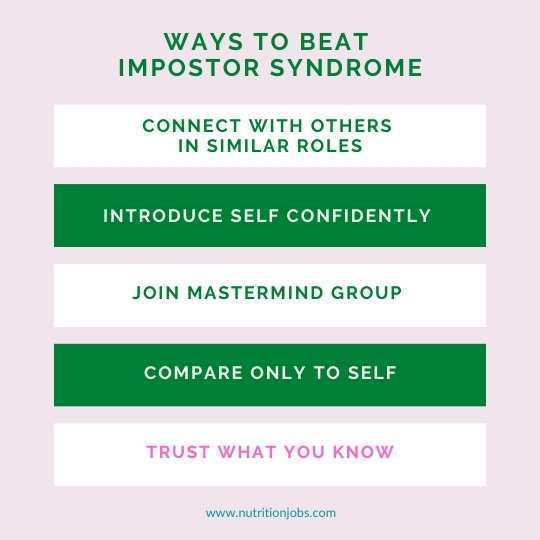
No Comparison. Matthew Landry, PhD, RDN, Postdoctoral research fellow and registered dietitian nutritionist at Stanford University’s School of Medicine, Twitter: @TheGuyititian, shares, “compare yourself to…yourself. Remember, the only person who it is fair to compare yourself to is you. Take time to ask yourself: Are you a better version of yourself today than you were yesterday? Have you improved in ways you wanted to from where you were a year ago?”
Fake It Till You Make It. Amy Gorin, MS, RDN, co-creator of the Master the Media Coaching Program, coaches people to find their inner confidence and get gigs working in the media highlighting one’s dietetic expertise and knowledge. Gorin emphasizes, “fake it till you make it! Seriously, the more you act like you feel confident, the sooner you will actually begin feeling confident.”
Step Ahead. Colleen Christensen, RD, founder of No Food Rules and The SociEATy Intuitive Eating community, updates, “remember, you don't need to know it ALL before helping someone. Being just a few steps ahead of someone gives you plenty of knowledge to help them take those steps, too.”
Trust What You Know. Kacie Barnes, MCN, RDN, toddler/kids dietitian and founder of Mama Knows Nutrition, explains, “remind yourself that you don’t have to be the top expert to help someone; you only need to know more than they do. Think of someone who has impacted your life who wasn’t a leading expert or guru- I’m sure you can think of plenty! Your expectations of yourself are always higher than anyone else’s.”
You Are As Smart. Jinan Banna, PhD, RD, registered dietitian helping women lose weight, clarifies, “consider that confidence, which white males often display in abundance, does not equal competence. Even though you might not present yourself in the same manner as they do, this doesn't at all mean that you are not as smart.”
Confident First Introductions. Landry notes, “When introducing yourself, never say, ‘Oh, I’m JUST the dietitian.’ You should always firmly and confidently say, “I AM the dietitian.”
Connect With Others. Karolina Starczak, MS, RDN, LDN, CEO of Nutrimedy, informs, “connect with others who are in similar roles. Having a full understanding of the details around a position really makes it less intimidating and can help identify any skills that need to be developed to be successful.” Connecting with other dietitians can help boost confidence by learning from others and having a support network.
Get Help. “We get by with a little help from our friends,” sang The Beatles. Consider seeking help from professionals or trusted people to share your feelings and concerns so you can begin to implement specific tools that will help change your thinking to be more conducive towards your true actions and growth.
You Were Invited. Bonnie Taub-Dix, RDN, says, "remember that there's a reason why YOU were asked to give the speech, write the story, answer that question. Now go out and get the experience you deserve!".
Find a Support Group. Brooke Schantz, RD, CSSD, @bitchinnutrition offers this advise, "Finding a mastermind group, dietetic support group, and/or mentor is so helpful!".
Giving Name To What It Is. Or isn't. Jessica Serdikoff, RDN, of @empowering.dietitians suggest that "naming that inner mean girl and inner critic is the first step to putting it in its place and learning not to believe everything it tries to tell you.
Get Out Of Our Own Way. Landry advocates, “If the impostor syndrome is holding you back, making you feel small, or burning you out, everybody loses. Sometimes, we have to get out of our own way, not just for ourselves, but for our clients and patients, our profession, and for our community of family and friends. When we’re able to overcome feelings of impostor syndrome within ourselves, within others, and across our profession at large, the true value and potential of RDNs will be realized.”
Resources to Beat the Impostor Syndrome
Audrey Ervin, Matthew Landry, Jaime Schwartz Cohen, and Chere Bork, spoke about the Impostor Syndrome during the 2020 Food and Nutrition Conference and Expo hosted by the Academy of Nutrition and Dietetics. The session was titled, Power In Your Presence: Taming Feelings of Insecurity and Imposter Syndrome. It included case studies and deconstructed the history of the impostor syndrome. In addition, it provided further tips and tools for dietitians to mitigate and counteract the negative effects of the imposter syndrome and focus on advancing the dietetic profession instead.
The Journal of Nutrition Education and Behavior published, You Are Not an Impostor: The Registered Dietitian and Nutritionist and Impostor Phenomenon, on March 26, 2021. Written by Matthew Landry, Dylan Bailey, and Audrey Ervin, the researchers share a breakdown of how the Impostor Phenomenon interferes with advancing one’s career and taking advantage of career opportunities. The paper further discusses implications within the dietetic industry and how nutrition professionals can counteract this phenomenon.
Food and Nutrition Magazine also shared an article written by Esther Ellis on December 21, 2020, titled, Fakes, Phonies, and Frauds: Dealing with Feelings of Imposter Syndrome. The article discusses the consequences of falling into the trap of believing the impostor syndrome and how to fight the feelings of fraudulence.
There is also a website devoted to the Impostor Syndrome: ImpostorSyndrome.com
They have a book, The Secret Thoughts of Successful Women: Why Capable People Suffer from the Impostor Syndrome and How to Thrive in Spite of It, written by Valerie Young, Ed.D. The website and book focus on getting rid of needless self-doubt that inhibits people from reaching their full potential and limiting their feelings of inadequacy.
*Dylan Bailey and Matthew Landry are also in the process of conducting one of the largest research trials to-date in the nutrition and dietetics profession to better understand the prevalence and contributing factors of the Impostor Phenomenon within the dietetic profession. The results are expected to be submitted to be published in the fall of 2021.
Other Articles You Might Like
Dietetic Work Journal Download
Dietitian Side Hustles to Increase your Dietitian Salary
Virtual Job Interview Checklist
Letters of Recommendation Checklist
How to Become a Sport Nutritionist
Highest Paid Dietitian Jobs by Location
Best Alternative Jobs for a Dietitian
About the Author
Sarah Koszyk, MA, RDN, is a Registered Dietitian and Sports Nutritionist specializing in Weight Management and Sports Nutrition for youth and adults. She writes articles for multiple publications, provides customized nutrition coaching, and is a brand spokesperson. She is founder of MIJA, a superfood supplement company, and Haumea Health, a fertility wellness clinic. Connect with her on Facebook, Twitter, Instagram, YouTube, or LinkedIn.
