
How to Become a Health Coach
Did you know that if you added a certification in health coaching to your nutrition practice you could expand and enhance your business as a dietitian. Here's what you need to know.
How Health Coaching Fits into Wellness Programs
More than half (51%) of employers (with a workforce of 50 or more employees) now incorporate wellness programs at the corporate level for overall health, better health, and for chronic conditions, with nutrition programs and exercise programs. Many of these programs include health coaching, with positive psychology, according to the Huffington Post. This is an amazing opportunity for you, whether you are in private practice or corporate wellness as a certified health coach dietitian.
As a registered dietitian nutritionist (RDN), you may already practice the art of counseling for behavior change (with a personalized approach) with chronic diseases with wellness goals in mind. One form of counseling can be classified as Health or Wellness Coaching.
This article provides a comprehensive look into the specialized field of the Health Coach, including what they do as health professionals and health educators, the career path to become one, certification programs, job opportunities, resources, and the Health Coach Salary.
Health and Wellness Coaches Defined
Health Coaches are “wellness authorities and supportive mentors who educate clients through lifestyle and behavior adjustments,” according to the Institute for Integrative Nutrition.
In the past 15 years, the field of health coaches has tripled and big names such as Dr. Andrew Weil, Director of Integrative Medicine, Dr. David Katz, director of the Prevention Research Center at Yale University, and Deepak Chopra, world leader in mind-body medicine, are leading the field.
Health and Wellness Coaching incorporates various counseling techniques, such as motivational interviewing, which allows a coach to perform an assessment with the client and establish a collaborative problem-solving and goal-setting situation. Wellness coaches have the enhanced skills to help their clients figure out what goals they want to accomplish and the action steps needed to take, to reach those goals. Also, if finding internal motivation is a challenge, a health and wellness coach can use their tools to bring out that internal motivation within their clients and make those health goals a reality.
What Health Coaches Do
You may already work with clients one-on-one or run group programs and workshops. By gaining the additional education of a health coach, you can better assist your clients to identify their roadblocks, break through their barriers, and help them reach their goals.
Learning how to coach and listen to the clients with a passionate and patient demeanor can result in empowering the client to implement long-lasting positive change in one’s wellness.
Coaches work with clients in private practices to establish goals versus traditional counseling of telling a client what to do in the hopes that the client follows what was dictated.
Coaching is a trained art and proper coaching programs provide the necessary tools to better fit the success of the client.
Typically, a health coach will:
- Assess the client’s current health condition.
- Develop a vision statement which also includes establishing motivational factors.
- Establish goals determined by the client which coincide with the vision statement.
- Depending on the stages of change that the client is at with his/her goals and vision statement, an action plan will be established focusing on using SMART goals to determine the course of action needed to reach the goals.
- This process encourages change from within and is client-centered where the client is “leading” the session and the coach is guiding and assisting the client.
- Schedule follow-up sessions.
- Chart and document all sessions.
Benefits of Becoming a Health and Wellness Coach
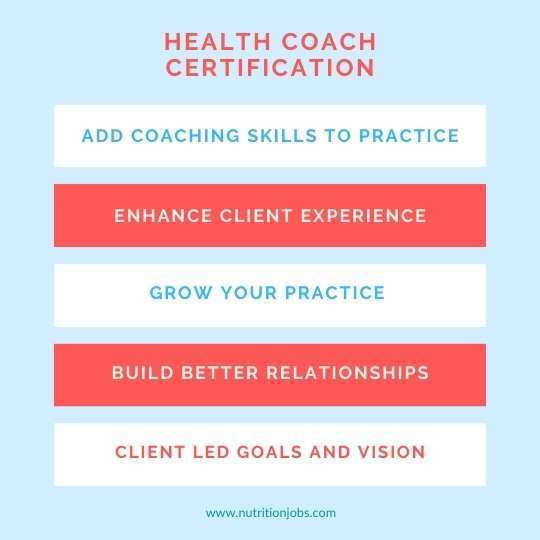
- Enhance client’s experience. Coaching can assist clients with making lifestyle changes that focus on the client’s needs, values, visions, beliefs, and goals. Coaching helps client set, establish, and implement action plans and define specific goals they want to reach.
- Increased salary. Additional certifications and credentials can result in higher pay rates and salaries.
- Build better relationships. Having a coaching background helps practioners listen to the needs of the clients, which can enhance rapport and optimize outcomes.
- Grow one’s practice. Increased client satisfaction results in increased word-of-mouth referrals, which results in increased business opportunities.
How to get Certified as a Health and Wellness Coach
While there isn't a gold standard for certification, many schools are available for training in the coaching process. Most of these schools also offer marketing and private practice education within their programs in order to teach you how to promote your services and run a successful business. You can find schools online or in your area.
Most of these schools also offer marketing and private practice education within their programs in order to teach you how to promote your services and run a successful business. You can find schools online or in your area.
Certification Through the National Board for Health and Wellness Coaching (NBHWC)
Here is a list of some of the approved coaching programs by the National Board for Health and Wellness Coaching (NBHWC) in alphabetical order:
Access the entire list of 83 approved training programs from the NBHWC.
- ACE Fitness: self-guided online health coaching program, American Council on Exercise Health Coach Certification, as a nutrition professional, a personal trainer, or with a background in exercise science.
- Dr. Sears Wellness Institute: online health coach program that is 6-weeks long and includes the basic health coach training. There are 3 additional specialty courses for the 3 stages of life and each specialty course is an additional 3-weeks. They also offer a Master Certified Health Coaching program after completing the initial health coach certification program which is 6-months long.
- Duke Integrative Medicine Health and Well-Being Coach: online and in-person health coach program at Duke University in Durham, North Carolina, which does require a bachelor’s degree or 3 or more years work experience in a medical or allied health field to apply. The online program is 10 months. The in-person program is 8 months.
- Health Coach Institute: online health coach program that is 6-months including 24 video lessons plus 40 hours of live, mandatory class time, and 1:1 coaching.
- Institute for Integrative Nutrition: online health coach program. There are 2 options for this program. One option is a full one-year program for people who may be working or taking care of a family. The other option is a six-month accelerated, intensive program that incorporates everything from the one-year program into just six-months.
- Mayo Clinic: online health coach program which includes 12 modules and a 4-day intensive, virtual workshop. Mentorship and peer coaching is also included.
- Wellcoaches: Also endorsed by the American College of Sports Medicine, this coaching school provides both in-person and online programs which require at least an Associates degree or more to apply. In order to get certified, one must complete 3 modules. The first module ranges in time from a 4-day session to a 9-week session. The other 2 modules include further education, mentoring sessions, and practice sessions.
How to get certified by the NBHWC after completing a Health Coach Program.
Once completing an approved health coaching program, you can then be eligible to apply to the Health and Wellness Coaching Certifying Exam to become a National Board-Certified Health & Wellness Coach (NBC-HWC).
Applicants who apply for the NBC-HWC must complete the following first:
- Have an associates degree or higher or 4,000 hours work of experience.
- Complete an NBHWC approved training program.
- Complete 50 health and wellness coaching sessions.
- Fill out the application.
Although a bachelors degree is not required to obtain the health coach certification from all of the programs (some programs require it), many employers prefer health coaches to have a bachelor’s degree in a related discipline such as nutrition, fitness, psychology, wellness, nursing, healthcare, or counseling.
Certification through the ICF
The International Coaching Federation (ICF) is another organization which certifies coaches and classifies them as an Associate Certified Coach (ACC), Professional Certified Coach (PCC), and/or Master Certified Coach (MCC). For more information about these credentials, check out the ICF.
Schools recognized by the ICF are:
Coach U: CoachU also has an advanced Master’s and International coaching program in addition to the basic in-person or virtual training program. The basic programs provide 77 hours of training. Upon graduation of the basic program, graduates can apply for the Associated Certified Credential through the ICF. The advanced programs are 4-day programs.
Jobs for Health Coaches
The health coaching industry is rapidly growing and even organizations such as the Mayo Clinic are now offering training programs due to the increased demand for health coaches. According to the American College of Sports Medicine, health and wellness coaching was ranked number 11 in the review of the top 20 worldwide fitness trends in 2021.
There are many job opportunities for Health Coaches and the list is continuously growing. Check out what the credential can lead to:
- Private practice
- Virtual health coaching companies
- Insurance companies
- Specialty healthcare organizations
- Care coordinators
- Hospitals
- Functional medicine practices
- Community clinics
- Spas
- Corporate and worksite wellness programs and facilities
- Schools and universities
- Spas
- Weight loss centers and clinics
- Health food stores
- Gyms and fitness centers
- Tech companies
- Digital medicine and wellness companies
Health Coach Salary Range
Health Coach Salaries range in pay based on location and type of practice.
Depending on the city you live in, different facilities will have different hourly and salary pay rates. In addition, based on the cost of living in the area, health coach salary rates will vary, too. To determine what to charge within a private practice setting, contact other local private practice health coaches to find out the standard going rate.
According to a 2021 Health Coaching Market Report, health coaches earn about $50,000 to $100,000 per year which is about $25 to $100 per hour. The report analyzed about 127,100 health coach and health educator jobs to determine this average.
LinkedIn lists the median health coach salary as $46,600 per year based on the average jobs posted.
Glassdoor lists the median health coach salary as $45,523 per year.
Ziprecruiter lists the median health coach salary as $48,227 per year.
It is also important to note that since health coaching is a relative newer field, there is some confusion among job descriptions which may also result in altered statistics and data analysis. Previously, the term “wellness coaching” was primarily used. And in some cases, only “health coaching” was used. Currently, more and more places are integrating both the terms health and wellness coaching which makes it a little more complicated when determining statistics.
Resources for Health Coaches
Here is a list of resources for Health and Wellness Coaches:
Institute of Coaching – an affiliate of Harvard Medical School
International Association of Health Coaches
International Coaching Federation (ICF)
National Board for Health and Wellness Coaching (NBHWC)
National Society of Health Coaches
PDHI Wellness Platform – tools for health coaches
Other Articles You Might Like
Dietetic Work Journal Download
Dietitian Side Hustles to Increase your Dietitian Salary
Virtual Job Interview Checklist
Letters of Recommendation Checklist
How to Become a Sport Nutritionist
Highest Paid Dietitian Jobs by Location
Best Alternative Jobs for a Dietitian
About the Author
Sarah Koszyk, MA, RDN, is a Registered Dietitian and Sports Nutritionist specializing in Weight Management and Sports Nutrition for youth and adults. She writes articles for multiple publications, provides customized nutrition coaching, and is a brand spokesperson. She is founder of MIJA, a superfood supplement company, and Haumea Health, a fertility wellness clinic. Connect with her on Facebook, Twitter, Instagram, YouTube, or LinkedIn.
