
Nutrition Blogging To Earn More Money as a Dietitian
Nutrition blogging can help you earn passive income and active income online as a dietitian, as a dietitian-to-be, or as a nutrition professional.
Nutrition blogging can be a way to increase your nutritionist salary or dietitian salary, whether you blog full-time or part-time as a side hustle. Blogging as a dietitian is also a great way to earn a steady income on the side. My own blog on NutritionJobs steadily earns several hundred dollars monthly in passive income.
In fact, nutrition blogging or food blogging by dietitians has become one of the most popular ways to make money online.
Lots of registered dietitians have fantastic success stories about how their own nutrition blogs and food blogs have earned even more money as passive income. Fellow Dietitian Katie Dodd, of the Dietitian Side Hustle* has a Blogging Accelerator Course* that teaches you how to successfully blog in a supportive, guided, and action-able program. Her 8-week guided course with coaching shows you how to create a blogging website, how to research your blog topic, how to outline and write your blog article to generate the most traffic, and more.
In this article I'll share how I earn money nutrition blogging and the two most important tools* I use to write successful blog articles for my website, so that you too can also earn income as a nutrition blogging dietitian.
Best niches for nutrition blogging
As a nutrition professional, you can reach your target audience with your online blog. Not sure what your target audience is? That's the idea behind finding your niche, your special area of expertise and the people that will benefit from your expertise.
You might have an expertise as a nutritionist, but also keep in mind what people are searching for and what you should consider addressing in your nutrition blog.
Once you find the best niche for blogging, unique to you and your expertise (or interest), you can be a successful blogger too.
Here are some of the top general niche areas for blogging: health, wellness, food, fitness, travel, motherhood, parenting, pregnancy, fertility, and more.
Here are a few of the top searched nutrition blog niches on Google:
-
adult takes on kid favorites
delicious recipes
diet culture
favorite recipes
food allergies
food photography
fresh produce and nutrition
gluten-free diet
good food
good health
good nutrition
green kitchen stories
health benefits of nutrition
healthy eating
healthy food blog
healthy lifestyle and nutrition
healthy living and nutrition
healthy recipes
holiday season and nutrition
holistic nutrition
intuitive eating or weight at any size (actually the top search term is weight loss but you can find a healthy approach to that topic)
meal plans
mental health and nutrition
menu planning
nutrition advice
overall health and nutrition
paleo diet
product reviews and nutrition
real food
recipe book and ebooks
seasonal produce recipes
self care and nutrition
sustainable nutrition
vegan diet
vegan recipes
whole foods
Benefits of nutrition blogging
Nutrition blogging is simply writing nutrition-related articles, or food articles, or recipe articles, that you publish on a website for visitors to read.
Visitors can find your blog articles by going directly to your website or by entering a search term, such as "cover letter examples for dietitians", into their search engine (like Google or Bing) and discover your article, along with others that are similar. More visitors organically coming to read your blog articles generates more traffic to your website.
Traffic to your website can help build your business (or help you earn money) in the following ways:
- reach a larger audience with your expertise
- build your business brand
- attract more clients
- attract more collaborations with other dietitians, chefs, or health professionals
- attract food brands for sponsorship opportunities
- advertising revenue by placing ads (through an ad server company) on your website
- more visitors attracted to your digital products, such as paid courses or paid downloads
- more visitors signing up for your paid group or individual counseling sessions
- more visitors buying your book
- more visitors buying your menu planning subscription service
- more visitors signing up for your webinars or virtual events
How my blog earns passive income every month
I happened upon blogging as a revenue stream accidentally a while back. I have been writing blog articles for many years as a free service for my audience on NutritionJobs. I noticed that a few articles I had written were generating thousands of website sessions (a term for website traffic).
That caught my attention because I have hundreds of blog article posts on my website, but only a few were getting all of the website traffic. I wondered what made those articles more popular and so interesting! I also wondered how people were finding these articles.
How Search Engine Optimization (SEO) helps blogging
It turns out that the readers were searching for these articles! They were searching for the keywords I had in those articles. They were typing keywords into their search engine (e.g., Google or Bing) trying to find answers to their questions. They were "googling" those keywords and long-tail keyword phrases (a string of keywords).
For example, people were searching for "how to become a functional nutritionist" or "what is a sports dietitian". Coincidently, I had blog articles on my website that answered those questions for the reader. And a lot of readers had those questions.
That's Search Engine Optimization, or SEO.
That motivated me to apply for an Ad Revenue Service to monetizing my blog. I quickly began by making advertising revenue just from the website traffic alone. That's when I decided to work on blogging with more intention.
Here's a great link for getting a crash course in SEO.
How to write a blog article that gets more traffic
So now I reverse engineer what blog article topics we write about to post on NutritionJobs. I'm not just writing about what I think is interesting anymore.
I want to write about what readers want to read; what readers want to know. And in doing so, I can generate more income from those articles from an Ad Revenue Service, affiliate marketing, and more revenue for my business products, such as my paid courses and paid resume temple downloads.
In this video, blogging expert Katie Dodd, MS, RDN, CSG, LD, FAND outlines how to drive more traffic to your blog.
Here's what I did to boost my website traffic
To boost my website traffic quickly, I did a few things things:
- SEO Course - I enrolled in an SEO course* . There are several SEO courses out there, but this one is truly the best (and easy to understand and implement): The SEO Made Simple Course* by fellow Dietitian Erika Julson. Erica provides detailed instruction in an easy-to-understand format and cadence that really works.
- SEO Keyword Research Tool - KeySearch is an inexpensive tool that does the keywords research for you. You simply enter your keyword topic idea and KeySearch calculates the search volume and difficulty for that keyword.
- SEO Keyword Article Generator - Once I decide on a keyword or keyword phrase I then enter that into RankIQ*. Using RankIQ* has really made the difference in how much traffic I was able to receive. It generates a list of related content, keywords, and phrases that I need to include in my article to improve my writing to meet my reader's search intent so that I can provide the very best content.
I noticed that once I enrolled in an SEO course* and started using these two SEO tools, my overall traffic has doubled. I write new blog articles that people want to read and I was able to revise old blog articles to boost traffic, as well, using these strategies.
Steps to writing a nutrition blog article post that will generate revenue
There is a system, or a recipe, to follow that can help you write a nutrition blog article that gets more traffic and, in turn, can earn you more revenue. Here are the two basic steps that you need to do.
1. Find a Topic - I used to only write about topics I was interested in. Well, that isn't always what my audience wanted to read! You can find out what topics people are interested in, and are searching for via Goggle or other search engines, using query tools.
For example, you might be interested in writing an article about Cobb Salad Recipes. With this topic idea you can then do keyword research. What is keyword research?
2. Topic keyword research - Once you find a topic that will likely get a lot of traffic without much competition, then you can find keywords and keyword phrases to use in your article so that it can be found in searches.
The keyword research query tools include Key Search, SEM Rush, and others will help to identify your general topic.
Writing a blog post simply about that popular search topic will likely get lost on page 5 of the Google search results because more popular websites, like www.simplyrecipes.com, will rank higher for that recipe. People click on the higher ranked websites.
But if you write about Crispy Chicken Cobb Salad, you have a better chance of ranking higher on Google, and thereby getting more clicks and traffic to your blog article. It's a subtle but significant difference if you want to be a successful nutrition blogger.
3. Content research - Now the fun part comes. You get to research what you are going to write about. Not writing, but researching. Develop the perfect recipe, understand the different types of magnesium supplements, read about baby weaning techniques.
4. Writing - Now put all the content research and relevant keywords into writing. Just write. This is not the time to edit - that comes later! Here are some specific tips:
- Start with an outline and fill in the sections.
- Use your authentic voice and make the words readable and approachable.
- Add interlinks (your website) and hyperlinks (other websites)
5. Optimize your keywords and blog article content - Now that you have your topic, your keywords, your content research, and your general outline, there is a recipe for how you structure your blog post so that it gets more readers and website sessions. There is a tool for that!
I started using RankIQ* and found that my blog posts immediately started getting more traffic. I was an early adopter of RankIQ*. I subscribed for one month, thinking I would discontinue my subscription after a short time, but I love it!
RankIQ* calculates additional keywords that are relevant to your topic that you should also include in your article and gives your writing a predicted grade.
I'm keeping RankIQ* because I love how it organizes my keywords and content for the best SEO. It's a keeper!
6. Edit - Now is the time go return to your article and clean it up.
7. Publish and share - Once you are done writing, submit publish. Market
Best Nutrition Blogging Tools
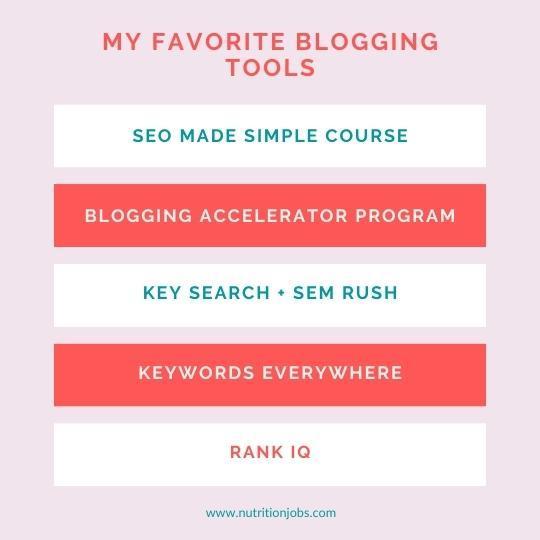
There are several pro tools that nutrition bloggers use to really boost the return on their effort. Here is a summary of the best nutrition blogging tools to use to increase your blog traffic strategically, which in turn can generate more revenue (while you play). Some of these are affiliate links, denoted by the *.
SEO Made Simple Course* - Dietitian Erica Julson, of The Unconventional RD, created this course with exceptional and comprehensive thought, detail, technical expertise, and perfect cadence! I am such a fan. I personally would not have found a more streamlined process on my own, or piecing together information on the topic of SEO through other courses, podcasts, or YouTube videos. It's an investment but you will likely see a return on that investment within a few months.
Blogging Accelerator Course* - Dietitian Katie Dodd, MS, RDN, CSG, LD, FAND has a guided course and coaching program that teaches you how to successfully blog in a supportive, guided, and action-able format. It's her "8-week signature program to launch dietitians into the online space making money through multiple income streams without seeing patients. Each week is broken into 4 components: an Intro, core learning content, resources to download, and action items. This course helps you learn how to approach blogging as a business."
RankIQ* - Knowing what to write about is the first important step. But knowing how to structure the writing, which keywords to use that will generate traffic (and not get buried beneath more popular blogs on page 6 of Google search), where to place those keywords and keyword phrases in the post, and what to title your post actually matters. Let the robots help! For an affordable monthly subscription you get all fo that. I have loved using this tool.
Food Blogger Pro Membership* - Members have access to blogging tools, articles, videos, and more. Members have access to a new course, Pinterest Course for Food Bloggers . I have found this to be an incredible resource for food blogging and food photography.
Ad Revenue Services for Blog Monetization
Make Money Nutrition Blogging
Nutrition blogging is a great way to earn income. There are several key tools to help you start writing top ranking blog articles to get more website traffic.
Food Blogger Pro has an ebook on how to monetize your food blog that you might find helpful. This video is helpful as well.
I can't wait to see what you create!

How This Tool Can Get Your Blog Post to Rank #1 on Google
RankIQ* is an AI-Powered SEO Tool that helps you make blog post outlines in minutes, create content in half the time and get access to the lowest competition keywords in your niche. It's truly magic. I highly recommend this tool. It was created by The Blogging Millionaire, Brandon Gaille. He is widely known as a successful blogger with a super helpful podcast, The Blogging Millionaire podcast. He shows you how to get more website traffic for your blog.
This is how I use RankIQ:
- Create SEO optimized blog titles
-
Organize my blog outline and content to rank #1 on Google
- Optimize old blog posts to improve layout, content, keywords,
- Use their keyword library for easy and perfect keyword research for the most profitable blog topics
- Create my own keyword library for my own niche topics
Additional Blogging Resources
Affiliate Links
Please note: This page contains affiliate links. If you choose to purchase a product using my affiliate link, I will receive a small commission or bonus. This will in no way impact the price you pay. Affiliate links on this page are denoted with an asterisk (*).
Other Articles You Might Like
Dietetic Work Journal Download
Dietitian Side Hustles to Increase your Dietitian Salary
Virtual Job Interview Checklist
Letters of Recommendation Checklist
How to Become a Sport Nutritionist
Highest Paid Dietitian Jobs by Location
Best Alternative Jobs for a Dietitian
About the Author
Stacey Dunn-Emke, MS, RDN, is the Founder Owner of NutritionJobs and an established dietetic career expert. She helps steer dietetic and nutrition professionals to a successful job search process with the top-ranked dietetic job board platform, NUTRITIONJOBS. Stacey is the author of The Dietetic Resume Guide and numerous dietetic career action-ables. She gives the tools to create a modern standout dietetic resume to land that job interview, help with job interview prep, and with creating All-Star LinkedIn profiles. Stacey has interviewed and hired many dietitians and in running NutritionJobs since 2000, she has reviewed thousands of dietetic resumes. She works closely with dietetic hiring managers and recruiters to know what standout resume elements land a job interview.
