
Eating Disorder Dietitian Job Opportunities
Within the field of dietetics, there are many specialty niches where a registered dietitian nutritionist can further their nutrition counseling education to meet the needs of the clients.
One of these specialty areas is in the treatment of eating disorders (ED) and the eating disorder field.
Eating disorder treatment, eating disorder recovery, and treatment plans goes above the regular care of a person and can consist of varying levels of inpatient, outpatient, the recovery process, and even residential round-the-clock care.
This article shares what Eating Disorder Dietitians do, how to become one, the nutrition education process, the clinical experience, job opportunities and salaries, the ups and downs within the industry, and resources.
What Eating Disorder Dietitians Do
Dietitians play important roles in the specific needs and treatment of eating disorders. They help support the nutritional needs of the patients while also guiding the patients (and often family members) towards a better relationship with food.
A major aspect of the dietitian specializing in eating disorders is working closely with an interdisciplinary team comprised of therapists, mental health professionals, social workers, family therapists, psychologists, medical doctors, nurses, and case managers.
Since eating disorders have the highest mortality rates of all mental illnesses, working closely in an interdisciplinary team approach is necessary to optimize the health of the patient such that a healthy relationship (or healthier relationship) with eating and food intake, supplement use, and general healthy eating.
Depending on the clinic, facility, or practice, the day-to-day routine of an ED dietitian can consist of looking at weights (weight gain), lab results, and vitals daily to individualized meal planning and eating patterns to promote weight restoration, meal support, weight maintenance, or weight loss to providing counseling services, and more.
Building a strong sense of trust and rapport is key to ensure the clients’ needs are being met, working with difficult emotions (and guiding coping mechanism), and the appropriate recommendations are being made.
Jessica Setnick, MS, RD, CEDRD-S, founder of Understanding Nutrition, explains, “In general, the role of the dietitian is not well understood. It boils down to feeling a lot of the time like we’re swimming upstream or driving the bus from the backseat because often the dietitian is the most knowledgeable about eating disorders in addition to the most knowledgeable about nutrition.” Therefore, assisting others in understanding what the dietitian can do is important for people to better utilize their services and expertise.
Sample Eating Disorder Dietitian Job Responsibilities
The job responsibilities vary from practice setting and the type of clinicians employed in each setting. Here is a real-life list of job responsibilities that can guide as a template.
- Complete comprehensive eating disorder nutrition assessments and follow up consults
- Develop a plan of care based on assessment findings and client goals
- Facilitate 4-6 groups/week
- Create individualized Care Plans, including meal plans, supplement recommendations, behavior change skills and nutrition education resources
- Provide therapeutic interventions such as DBT/CBT, intuitive eating principles, and body image counseling, mindfulness practices
- Provide meal support sessions, grocery store support and exposures, including eating meals with clients and in a group setting
- Manage schedule and case load
- Document thoroughly using the electronic health record (EHR)
- Coordinate care with treatment members in a timely manner
- Attend networking and marketing events
- Maintain ethical practices established by the APA and AND
- Participate in weekly supervision and team meetings
How to Become an Eating Disorder Dietitian
After becoming a Registered Dietitian Nutritionist, there is additional training to take in order to specialize in Eating Disorders. For information on How to Become a Dietitian, check out this past article.
Here are the steps to take on how to get credentialed as an Eating Disorder Dietitian:
- The International Association of Eating Disorders Professionals (iaedp - the use all lowercase when referencing their acronym) provides certification for Registered Dietitians titled, Certified Eating Disorders Registered Dietitian (CEDRD).
- Certification criteria includes a minimum of 2,500 eating disorder practice hours under the guidance of an approved iaedp Supervisor completed within 2 years.
- An application must be completed including letters of recommendation.
- A case study must be submitted along with the application.
- An exam must be passed through the iaedp.
- Get more information on how to get certified through iaedp.
Pro-Tip: Corinne Dobbas, MS, RD, Registered Dietitian, Nutrition Therapist & Certified Intuitive Eating Counselor, advises, “Get regular supervision from a CEDRD-S (a Certified Eating Disorder Registered Dietitian - Supervisor). I recommend this regardless if you intend to pursue the CEDRD credential through the iaedp or not. This work is challenging and complex. Having a place to discuss client cases and get support is ideal to better support one’s clients. Supervision is typically provided by senior clinicians to review cases with self-reflection. Find a supervisor here. I see my supervisor every other week and am so grateful for the time we have together.”
Pro-Tip: Dobbas also emphasizes, “Join consult groups with local ED therapists and dietitians nearby if they exist. I am a part of two consult groups and am so grateful for the friendships I've made and wonderful colleagues I've met. To find groups like this, you can create your own or ask local ED professionals if they know of any."
Jobs for Eating Disorder Dietitians
There are many job opportunities for Eating Disorder Dietitians. Check out what the credential can lead to:
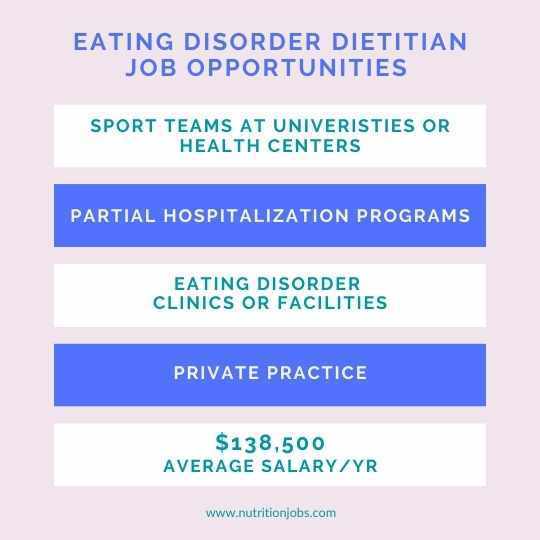
- Eating disorder facilities or clinics including inpatient and/or residential which may include round-the-clock care.
- Intensive outpatient programs.
- Partial hospitalization programs.
- Private practice.
- Marci Evans, MS, CEDRD-S, LDN, owner of Food and Body Image Healers, informs, “Working for sports teams and college/university health centers.”
- Rachael Hartley, RD, LD, owner of Rachael Hartley Nutrition, enlightens, “ED Dietitians can also work in facilities that aren't dedicated to treating eating disorders because eating disorders (and disordered eating) are FAR more common than most people realize.”
- Evans adds, “Eating disorders are quite common and more prevalent in populations who have diabetes, PCOS, and digestive health concerns so the sky really is the limit.”
- Setnick recommends, “As with any dietitian specialty, your credentials are just a jumping off point. After that, the opportunities are endless. You can work in all levels and types of healthcare settings, research, advocacy, education, speaking, writing, marketing.” Setnick has a successful practice speaking, writing, educating, and providing coaching and marketing services.
- Setnick concludes, “Visit EatingDisorderJobs to read about all the different roles that eating disorder dietitians have, including those who have created their own careers.”
Eating Disorder Dietitian Salaries
Eating Disorder Dietitian Salaries range in pay based on location and type of practice.
Depending on the city you live in, different facilities will have different hourly and salary pay rates. In addition, based on the cost of living in the area, private practice rates will vary, too. To determine what to charge within a private practice setting, contact other local private practice ED dietitians to find out the standard going rate.
According to ZipRecruiter, the national average salary for an Eating Disorder Dietitian is $86,811 annually which is about $42 per hour.
Top earners make an average of $138,500 annually with 2% of dietitians working in this area making about $231,500 - $254,500 annually.
Working in a private practice setting generally pays the most when compared with inpatient and outpatient facilities/clinics.
There are also many opportunities for virtual work for the ED dietitian.
Top Tips from Successful Eating Disorder Dietitians
It’s always great learning from the best in the field. Here is what inspiring ED Dietitians have to share.
Dobbas’ Top Tip: “Be gentle with yourself and show up to meet your clients with care and curiosity. I try my best to show up to every session with no agenda. Because I have no idea of what will help us get to the end goal of our work, but I believe in my core that my client knows. Of course, there may be some things that need to be discussed relative to the client's care and treatment, but if I step in with a firm agenda, there goes the curiosity and collaborative nature I need to have with my client to support them in getting nourished and well.”
Evans’ Top Tip: “First, consider your willingness/ability to invest a significant amount of time, energy, and money to learning and training. Eating disorders work is a specialty and requires a lot of resources and initiative to enter the field. Second, reflect on your own mental health and relationship to food/body. In order to thrive in the field, it's important you are in a healthy place yourself. No need to be perfect (there's really no such thing!), but you'll enjoy the work and be much more effective if you are reasonably well mentally and emotionally.”
Hartley’s Top Tip: “Developing solid counseling skills is by far and beyond the biggest piece of advice I have for dietitians who are interested in working with eating disorders. Of course, there is a lot to learn about medical nutrition therapy for eating disorders, as well as paradigms like Intuitive Eating and Health at Every Size, but without solid counseling skills, that stays as information in your brain, rather than information that helps your clients in their recovery. Learning about motivational interviewing, cognitive behavioral therapy, acceptance and commitment therapy and most of all, supervision, are a must. Dietitians often wonder if building these counseling skills is within their scope, and they absolutely are! I remind the RDs I work with that they're using these skills to help clients implement food and nutrition recommendations, not to process childhood trauma or solve marital problems (which is definitely outside our scope!).”
Setnick’s Top Tip: “Keep in mind that this field is in its infancy so no one has all the answers. You will need to stay flexible and be willing to not always have a definite answer to every situation. There are many philosophies and methodologies in our field and you’ll need to shop around before determining which specialty within eating disorders is the best fit for you.”
Biggest Takeaway: Continuing education, guidance, and support is key to having a successful ED practice.
Career Challenges as an Eating Disorder Dietitian
As with any job, there will be trials and tribulations. Because eating disorders are so complex, there can be many hurdles on the job. Lead ED dietitians share their top challenges and how to overcome them.
Dobbas: “The biggest challenge I think is the nature of an eating disorder, any eating disorder. The very thing that a client is distressed by: eating and eating enough for their body consistently throughout the day, without compensating with eating disorder behaviors or hurtful thoughts toward their body, is the very thing that we're trying to help them do. The other big piece is that we live in a culture and medical system that praises smaller bodies and stresses weight loss. We are striving to help our clients make peace with food and their bodies amidst a culture that is telling them the exact opposite. This becomes even more complicated in work with adolescents where the family system has core beliefs around food, nutrition, and body size that may be harmful to the client in recovery. A large majority of my caseload is adolescents. So, parent coaching is also something I have found invaluable in my practice to help a child heal while also providing the family with care and direction around food, nutrition, and body talk.”
Evans: “One of the biggest challenges is developing the counseling skills to work with complex mental health concerns. This isn't an area we get advanced training in as dietitians and it takes training, supervision, and time to feel more comfortable in this arena.”
Hartley: “Eating disorders are incredibly hard to treat. When you love your job, care about what you do, and most of all, care about the patients you work with, it's impossible to not put pressure on yourself to do your best with each and every client. I think every single dietitian who works with eating disorders has questioned their skills and expertise at some point, including many who you might look up to!”
Setnick: “Eating disorders are not well understood, so in the outpatient setting there are a lot of barriers we face just in trying to do our jobs and help people recognize that what’s going on is a severe problem.”
Resources for Eating Disorder Dietitians
Academy for Eating Disorders (AED)
The International Association of Eating Disorder Professionals (iaedp)
National Eating Disorder Association (NEDA)
Dobbas’ Top Picks:
Elizabeth Scott's Big Hearted Embodiment Training
The Two-Day EFFT Core Clinician Training with Dr. Adele Lafrance, C.Psych. Great for practitioners who work with adolescents and parents.
Any of Marci Evan's trainings
Any of Jennifer Rollin's trainings for clinicians
Eating Disorders: A Guide to Medical Care and Complications, 3rd edition by Philip Meher, MD, FAED, and Arnold Andersen, MD
Evan’s Top Picks:
Free resource entitled "The Dietitian's Guide on Where to Go for Eating Disorders Training." It lists many options for training from free, to low cost, to larger investments.
EDRD Pro provides a huge library of courses and webinars.
Hartley’s Top Picks:
Sick Enough by Dr. Jennifer Gaudiani, discusses the medical complications of eating disorders in an easy-to-understand way, and is written by a doctor who specializes in treating eating disorders.
Body Respect by Linda Bacon, PhD, and Lucy Aphramor, PhD, RD, which teaches the science behind Health at Every Size, a weight-inclusive paradigm.
Setnick’s Top Picks:
The International Federation of Eating Disorder Dietitians (IFEDD). There is a $10 membership fee for students before becoming a Registered Dietitian. There is a very active listserv and tons of member resources.
The Academy of Nutrition & Dietetics Pocket Guide to Eating Disorders
Other Articles You Might Like
Dietetic Work Journal Download
Dietitian Side Hustles to Increase your Dietitian Salary
Virtual Job Interview Checklist
Letters of Recommendation Checklist
How to Become a Sport Nutritionist
Highest Paid Dietitian Jobs by Location
Best Alternative Jobs for a Dietitian
About the Authors
Sarah Koszyk, MA, RDN, is a Registered Dietitian and Sports Nutritionist specializing in Weight Management and Sports Nutrition for youth and adults. She writes articles for multiple publications, provides customized nutrition coaching, and is a brand spokesperson. She is founder of MIJA, a superfood supplement company, and Haumea Health, a fertility wellness clinic. Connect with her on Facebook, Twitter, Instagram, YouTube, or LinkedIn.
Stacey Dunn-Emke, MS, RDN, is the Founder Owner of NutritionJobs and an established dietetic career expert. She helps steer dietetic and nutrition professionals to a successful job search process with the top-ranked dietetic job board platform, NUTRITIONJOBS. Stacey is the author of The Dietetic Resume Guide and numerous dietetic career action-ables. She gives the tools to create a modern standout dietetic resume to land that job interview, help with job interview prep, and with creating All-Star LinkedIn profiles. Stacey has interviewed and hired many dietitians and in running NutritionJobs since 2000, she has reviewed thousands of dietetic resumes. She works closely with dietetic hiring managers and recruiters to know what standout resume elements land a job interview.
Affiliate Links
Please note: This page may contain affiliate links. If you choose to purchase a product using my affiliate link, I will receive a small commission or bonus. This will in no way impact the price you pay. Affiliate links on this page are denoted with an asterisk (*).
