
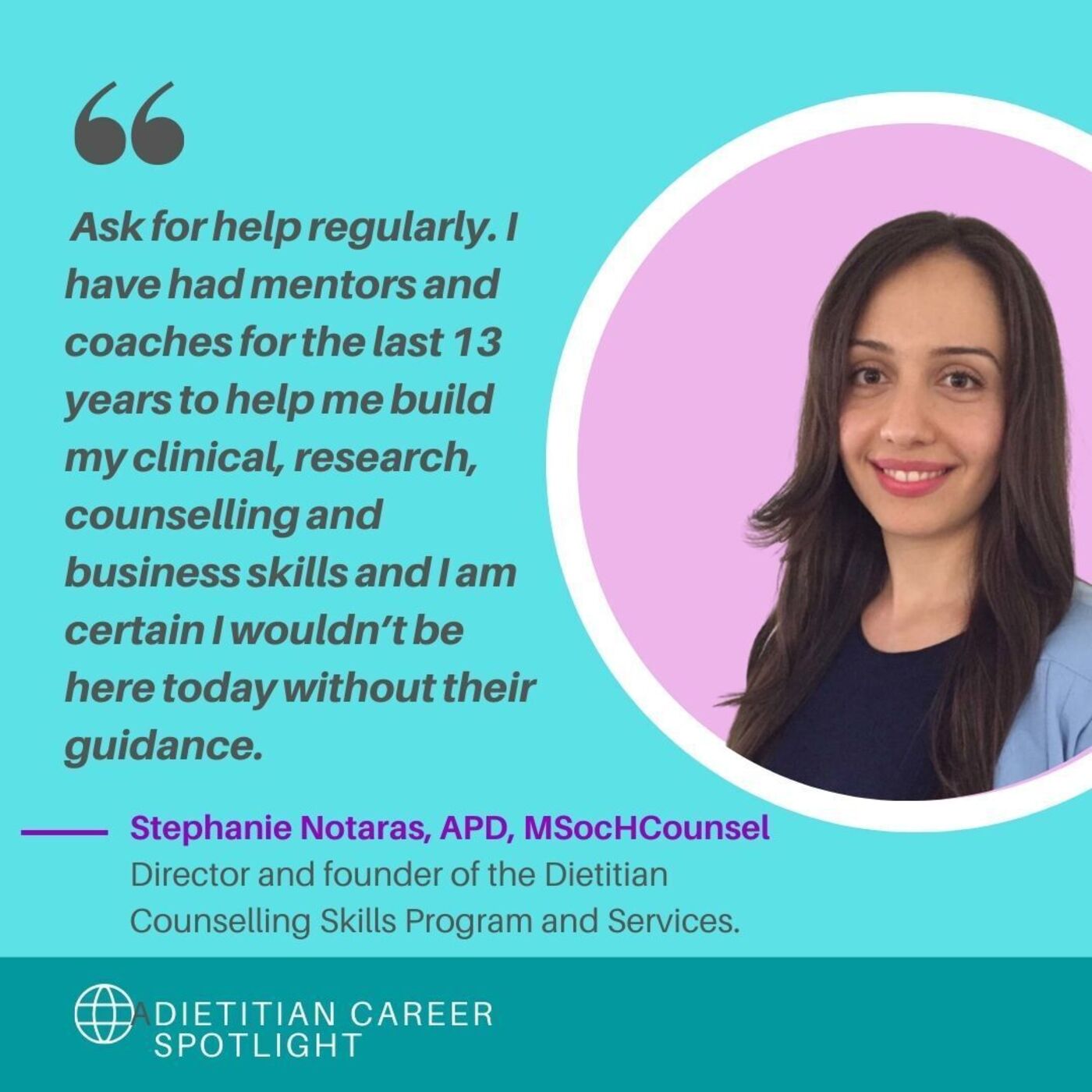
Dietetic Career Spotlight on Stephanie Notaras, APD, MSocHCounsel, Director and Founder, Dietitian Counselling Skills Program and Services
Meet Stephanie Notaras, APD, MSocHCounsel, Director and founder of the Dietitian Counselling Skills Program and Services. Stephanie is a practicing dietitian in Australia and is dedicated to helping other dietitians improve their counseling skills and client success rates. Through the creation of her online program targeted at helping Registered Dietitians, Stephanie is able to provide her effective counseling framework. This structure empowers practitioners to achieve positive patient outcomes, which I think is pretty neat! - Katie
What attracted you to the field of nutrition and dietetics?
To learn about the influence nutrition has on peoples’ lives and better understand the relationship people have with food, their bodies and their health. I see nutrition and eating psychology as an important aspect of optimizing overall health (mental and physical) and managing/treating medical conditions.
Company you are with now?
My own company Stephanie Notaras Pty Ltd. This company trains dietitians in counseling skills to improve client outcomes and retention to have more profitable and fulfilling businesses.
Your Job Title?
1. Director and founder of the Dietitian Counseling Skills Program and Services.
2. PhD candidate at Western Sydney University looking at the impact of dietetic intervention of CKD progression and behavior change strategies that can influence patient outcomes.
Website:
Social Media:
- Instagram: https://www.instagram.com/dietitiancounsellingskills/
- Facebook Group (Dietitians: Counselling Skills Community) - https://www.facebook.com/groups/dietitianscounselling/
- Free Masterclass: on Elevating Client Outcomes for dietitians to give you the skills to coach your clients from nutrition education to life-changing transformation- https://stephanie-notaras.mykajabi.com/dietitianmasterclass
A typical (or not so typical) day-in-the-work-life for you?
My days are split between dietitian training, mentoring and coaching and my PhD. I am interacting with dietitians on a daily basis supporting them with client cases, identifying areas for improvement in client retention and outcomes, and helping them upgrade their counselling processes to meet their practice goals.
Throughout the week I allocate time to my PhD - I am currently completing my final study looking at how clients perceive the role of nutrition in the management of CKD and what could help them implement nutrition changes more effectively. The goal of the PhD is to gather evidence to advocate for earlier access to renal dietitians for people living with CKD. Then when they do get to see a dietitian, for them to have effective counselling skills to help these people change their eating behaviours to improve their health outcomes.
How did you get your current job in dietetics?
I created the role within my company. In my previous role working for a large healthcare organisation, I had been invited to create an education program for dietitians to improve their communication and counselling skills as we are not taught these skills during our training in the depth required for a successful client practice.
The program was extremely successful in helping dietitians improve their confidence to counsel their clients towards behavior change and better outcomes. The framework was evaluated and published. The 50 dietitians who completed the first round of the program encouraged me to take it global so more dietitians could access the training to feel more skilled and confident in their abilities to help their clients. However, my role at the time had many other responsibilities (nutrition client care, service development, research, quality improvement, administration) and it was becoming challenging to allocate more time to training dietitians. This was the driving force to reducing that role, creating my company and the online Dietitian Counselling Skills Program.
What skills were you born with and what skills have you learned along the way?
I was born with a love of communicating and building relationships with others and a love of learning. Along the way I have learnt the imperative role communication and counselling have in any relationship (both personal and professional) and acquired the skills needed to become an effective communicator.
Throughout the journey I have had to learn:
1. How to make decisions from a place of intrinsic purpose to keep up the drive and commitment to my mission
2. Prioritisation skills to identify what needs to be done first and explain things from a point of value
3. A learning mindset of not expecting to get things right the first time
4. Reflective practice skills to deepen my understanding of myself and consider what is within my control to influence
5. Presentation, training and mentoring skills to ensure I am providing an optimal learning and growth experience for both dietitians and dietetic students (I lecture at universities on counselling skills). It requires a deliberate skillset to have people learning information effectively and applying it to their practice.
What advice do you have for others wanting to be just as successful and fulfilled as you?
Success looks different for everyone. For me, success is being able to dedicate my time to something that brings me purpose, fulfilment and revenue without compromising my health and relationships. From this perspective, I recommend finding what brings you purpose and focus on making progress (rather than just meeting externally driven indicators) to keep you motivated and committed to your mission.
Expect to struggle (we all do) and learn how to manage feelings of disappointment by assigning the right meaning to them (for example, they are part of the process and not a sign that you’re not cut out for something). Ask for help regularly. I have had mentors and coaches for the last 13 years to help me build my clinical, research, counselling and business skills and I am certain I wouldn’t be here today without their guidance.
If you could be paid for your job with something other than a paycheck, what would it be?
In this season of life with two young children, building my business and completing my PhD, I would be open to being paid in vouchers for domestic services and having meals prepared for me. It would give me back some time and energy.
About the author
Katie Padva, MS, RDN, LDN, is a Registered Dietitian passionate about delivering nutrition education through writing, teaching, and counseling to help prevent and manage chronic diseases. She works in a private practice helping individuals be the best version of themselves through healthy nutrition. She also works as an adjunct instructor at a University educating students on nutrition concepts. When she is not working, Katie enjoys being outside, running, writing, cooking, doing yoga and hiking! Connect with her on LinkedIn.
