
How (and Why) to Self-Publish Your Book as a Dietitian
Have you ever considered writing a book? It's a great way to connect with your target audience as a dietitian. There are typically two ways to publish a book: the traditional way with a publisher and self-publishing.
Self-publishing has revolutionized the book industry by providing dietitian authors with a direct path to their clients. According to a 2022 report by Author Earnings, about 30-34% of all ebooks sold on Amazon are self-published. This number has been steadily increasing in recent years, and it is expected to continue to grow in the future.
But what exactly is self-publishing, how does it differ from traditional publishing, and why you should self-publish a book?
This article will show you several ways to self-publish a book, why you should self-publish, and how to work with a dietitian who is an expert with the self-publishing process.
5 Reasons to self-publish a book as a dietitian
- Establish Authority: Having a published book in your name demonstrates your knowledge and expertise in your field. It positions you as an authority on a subject and increases your credibility among your clients, peers, and the general public.
- Reach a Wider Audience: Self-publishing allows you to reach a wider audience beyond your immediate clients or community. With online platforms, your book can be purchased by anyone around the world, enabling you to share your insights on a larger scale.
- Create Additional Revenue Streams: A self-published book can serve as an additional source of income. Once it's written and published, it can generate passive income over time through book sales.
- Provide a Comprehensive Resource for Clients: A self-published book can serve as a guide for your clients. Whether it's a cookbook, nutrition guide, or a diet plan, a book allows you to provide detailed and comprehensive information that your clients can refer to as needed.
- Freedom and Control: Self-publishing gives you full control over the content, design, and pricing of your book. You can tailor your book to meet the specific needs of your audience and make updates or revisions whenever necessary.
How to self-publish as a dietitian
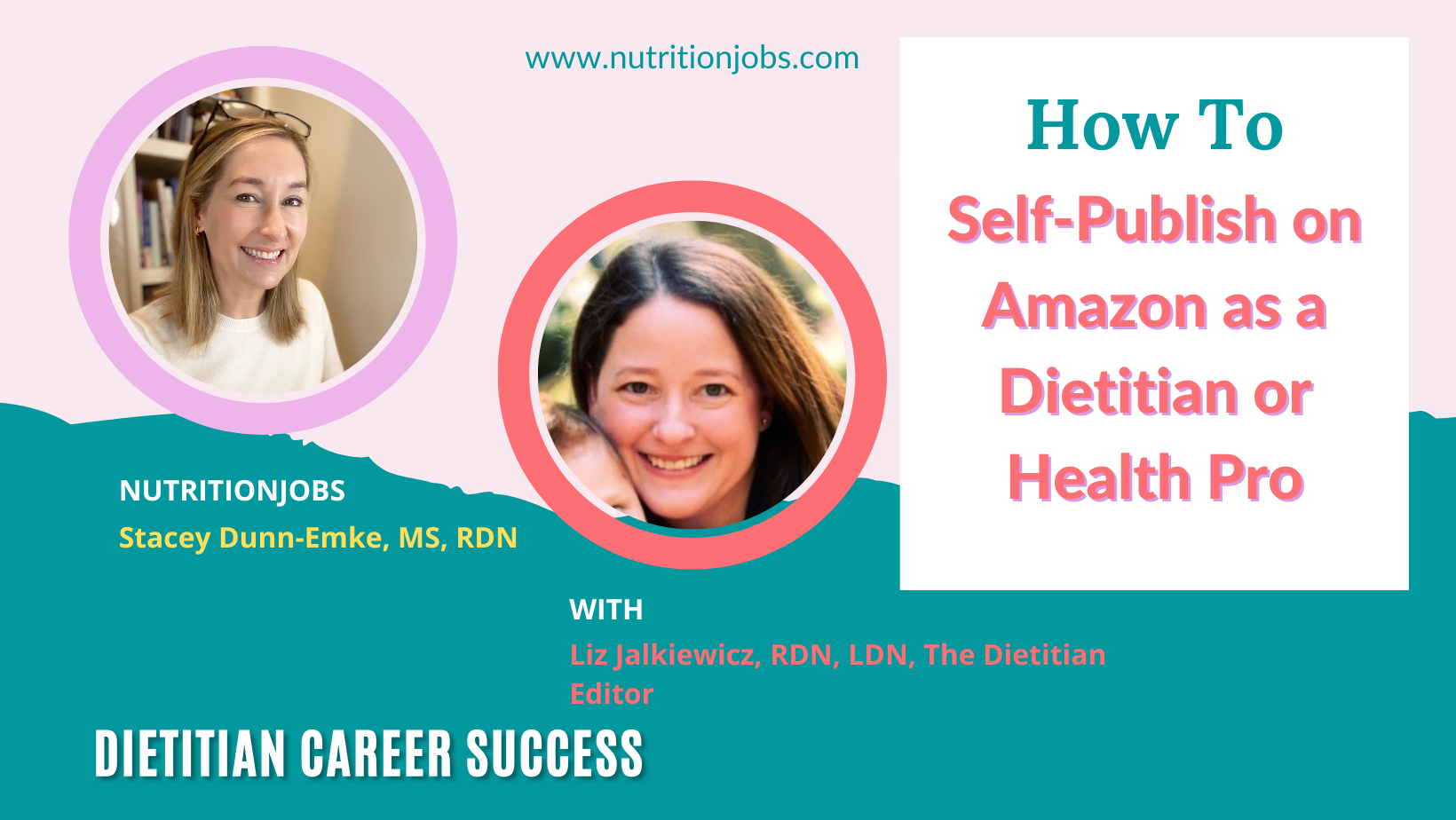
I interviewed Liz Jalkiewicz, RDN, LDN, the founder of The Dietitian Editor and course creator of Click to Publish*. She specializes in helping dietitians, dietitians-to-be, and other health professionals, with self-publishing. She has had numerous successful students who have completed her course and I highly recommend her as your guide to self-publishing!
Here are more of her resources found on The Dietitian Editor website:
THE DIETITIAN EDITOR
- Register for Liz's FREE Masterclass
- Learn more about Click to Publish* (affiliate link)
- Check out Liz's Blog on The Dietitian Editor
- Articles on self-publishing on her blog
- Join The Dietitian Editor Weekly Edit e-newsletter
- Follow Liz on Instagram
Traditional publishing vs self publishing
You are likely familiar with traditional publishing but I think it might be helpful to walk through the basic differences between traditional publishing vs self-publishing. Here is a brief overview of both processes:
Traditional book publishing
- Find an agent: The first step in traditional book publishing is to find an agent. Agents are literary professionals who represent authors and help them get their books published.
- Submit your manuscript: Once you have an agent, they will submit your manuscript to publishers. Publishers will then decide whether or not to publish your book.
-
Traditional publishers: Penguin Random House, Simon & Schuster, Hachette Book Group, HarperCollins, Macmillan Publishers, Little, Brown and Company, W.W. Norton & Company, Knopf Doubleday Publishing Group.
- Negotiate a contract: If a publisher decides to publish your book, you will negotiate a contract with them. This contract will outline the terms of your publishing deal, such as your advance and royalties.
- Edit and design your book: Once you have a contract, your book will be edited and designed. This process can take several months.
- Market and distribute your book: Once your book is edited and designed, it will be marketed and distributed. This process can take several months or even years. Often the author (especially a new author) will be responsible for the marketing and promotion of their own book.
Self-publishing
- Write and edit your book: The first step in self-publishing is to write and edit your book. You can do this yourself or hire a professional editor.
- Design and format your book: Once you have a finished manuscript, you will need to design and format your book. This includes choosing a cover, setting the page layout, and adding metadata.
- Publish your book: Once your book is designed and formatted, you can publish it through a self-publishing platform, such as Amazon KDP.
- Market and distribute your book: Once your book is published, you will need to market and distribute it. This can be done through online and offline channels.
Why self-publish?
The primary benefit of self-publishing lies in the authority it can bring you as a dietitian. Being a published author elevates your credibility as an expert in your niche. Furthermore, a book allows you to articulate your ideas at length, something that articles or blog posts may not do.
Dietitians in traditional roles can leverage a published book to reinforce their status as an authority in a particular niche, be it pediatric nutrition, sports nutrition, or diabetes management. It can aid in client education, providing a comprehensive reference that patients can return to time and again.
For dietitians in non-traditional roles, such as bloggers, influencers, or freelance writers, a published book can enhance your brand. It gives you a tangible product to market, expanding your offerings beyond digital content.
What to publish?
As a dietitian you can create a recipe book, a comprehensive guide to managing specific health conditions through nutrition, or a reference book on various nutrition plans (e.g., high fiber, high protein, dysphasia, and more.). The key is to pick a topic that resonates with your unique expertise and audience's interests. Here are some ideas:
- Nutrition guidebooks for patients. If you have expertise in a particular nutrition niche, you could write a guidebook for your patients or clients (or other fellow dietitians), such as gut health or gout management.
- Cookbooks. If you have a food blog, or are a recipe developer, you could write a cookbook.
- Meal plans. Either as an offshoot or your cookbook or guidebook, you could write a meal plan book as an accompaniment to your other publications.
- Low-content books. These are books that are mostly images or text, with very little narration. They can be a great way to share information about nutrition in a visually appealing way.
Examples of self-published books
Here are some book ideas to inspire your creativity that also includes low content and lower-content book formats.
- activity journal
- baby weaning tracker
- exercise log books
- fertility tracker log book
- good things journal
- gratitude journal
- habit trackers
- happiness journal
- hydration tracker
- lactation log book
- meal planners
- meal planning guides
- meal trackers
- menu journal
- nutrition guides
- planners
- recipe books
- snacking planners
- success tracker
- symptom tracker
- work success stories tracker (I'll make!)
- workbooks for courses
Self-publishing platforms
There are numerous self-publishing platforms and tools available to you as an author. Here is a list:
- Amazon Kindle Direct Publishing (KDP): As one of the largest and most well-known self-publishing platforms, Amazon KDP allows you to publish both eBooks and paperbacks. The platform offers comprehensive tools and a vast distribution network, reaching millions of readers worldwide.
- Lulu: Lulu offers a range of self-publishing services, including print-on-demand and eBook distribution. It also allows for the creation of photo books, calendars, and other specialty products.
- StoryWorth: While StoryWorth isn't a traditional self-publishing platform, it offers a unique way to collect and share personal stories in a professionally designed book. Each week, StoryWorth sends you or a loved one questions about life. The responses are collected, and at the end of the year, they are bound into a beautiful book.
- IngramSpark: Ideal for authors seeking broad, global distribution, including access to physical bookstores. IngramSpark offers both print-on-demand and eBook options.
- Draft2Digital: Known for its user-friendly interface, Draft2Digital offers wide distribution, including the major eBook stores (apart from Amazon) and some libraries.
- Smashwords: This veteran platform distributes to numerous smaller eBook retailers and libraries. They also provide several tools for promoting your book.
- BookBaby: Offering comprehensive services from eBook conversion to cover design and editing, BookBaby is a great all-in-one solution. They distribute to all major eBook retailers.
- Blurb: Particularly good for image-heavy books like cookbooks or photography books. They offer several book formats and options, including eBooks.
- Apple Books (formerly iBooks Author): If you're targeting Apple users, publishing directly on Apple Books could be beneficial. They offer some unique interactive features for eBooks, although the platform can be somewhat difficult to navigate.
Each platform has its own specific fees, royalty structures, and requirements, so be sure to thoroughly research to choose the best one for your needs and goals.
How you can make money as a self-published author
Self-publishing a book as a dietitian can open up several streams of additional income:
- Direct Book Sales: This is the most straightforward way of earning income. You write and publish a book, and then sell it through platforms like Amazon KDP and others.
- E-books: In addition to physical books, you can also publish your book in an electronic format. E-books can be distributed globally with minimal costs, and this could result in a significant income stream.
- Paid Speaking Engagements: As a published author, you'll likely be viewed as an expert in your field. This could lead to paid speaking engagements at conferences, seminars, webinars, and other events.
- Consulting: Your book can serve as a showcase for your expertise, leading to consulting opportunities. For instance, if you've published a book about pediatric nutrition, you might be hired as a consultant by schools or health agencies.
- Workshops and Courses: You can use the content of your book to create and sell related workshops or online courses.
- Subscription Services: If your book is part of a larger topic that requires ongoing updates (like a diet plan), you could create a subscription service where subscribers get regular updates or additional content.
- Affiliate Marketing: In your book, you could refer readers to products or services (e.g., nutritional supplements, fitness equipment, etc.), and earn an affiliate commission for every sale made through your referral.
- Sponsored Content: If your book gains enough attention, companies might approach you to write about their products or to include their products in your book.
What you need to know about Amazon metadata and keywords
An important step in the KDP self-publishing process is providing metadata for your book, which includes choosing keywords. These keywords play a critical role in making your book discoverable on Amazon.
The strategy here is to think like your potential reader. What terms would they type into the search bar when looking for a book like yours? Use a mix of broader, more competitive keywords (like 'fiber', 'nutrition', 'healthy snacks') and long-tail keywords (like 'high fiber vegan recipes', 'nutrition guide for diabetes').
Avoid using keyword phrases that are too vague or unrelated to your book's content.
Amazon KDP offers useful guidelines and the Click To Publish* (affiliate link) course walks you through exactly how to master keywords and metadata so Amazon shoppers can find your book.
Wrapping up
In the digital age, self-publishing presents a tremendous opportunity for dietitians and health professionals to amplify their voice and extend their reach. It's not just about creating a book; it's about sharing your expertise, establishing your authority, and making a positive impact in your field and beyond.
Whether you aim to educate, inspire, or provide practical advice, self-publishing platforms such as Amazon KDP, offers the tools to transform your words into a professionally published book.
Think about what unique insights you, as a dietitian, can offer. Maybe it's a cookbook full of nutritious recipes, a comprehensive guide to managing specific health conditions, a set of meal plans tailored to different dietary needs, or a visually appealing low-content book such as a symptom log. As a dietitian, your knowledge can guide people towards healthier, happier lives.
By self-publishing, you have the potential to make a meaningful difference while boosting your career and enhancing your credibility.
Expert guidance, like that offered by The Dietitian Editor, can help demystify the process and set you on the path to publishing success. It's time to step into your power as an author and share your unique insights with the world. So, why not start your self-publishing journey today?
About the Author
Stacey Dunn-Emke, MS, RDN, is the Founder Owner of NutritionJobs and an established dietetic career expert. She helps steer dietetic and nutrition professionals to a successful job search process with the top-ranked dietetic job board platform, NutritionJobs.com. Stacey is the author of The Dietetic Resume Guide and numerous dietetic career action-ables. She gives the tools to create a modern standout dietetic resume to land that job interview, help with job interview prep, and with creating Compelling LinkedIn profiles. Stacey has interviewed and hired many dietitians. Since running NutritionJobs in 2000, she has reviewed thousands of dietetic resumes. She works closely with dietetic hiring managers and recruiters to know the standout elements on a resume that land a job interview. Stacey speaks on successful compensation negotiation at professional conferences and frequently consults with the Academy of Nutrition and Dietetics at FNCE and co-created the webinar series, Dietetic Career Hack: The Complete Networking and Resume Guide and Dietetic Career Hack Part II: Interviewing Tips and Tricks. Her previous dietitian jobs have been in clinical, nutrition support, and research.
Affiliate Links
Please note: This page contains affiliate links. If you choose to purchase a product using my affiliate link, I will receive a small commission or bonus. This will in no way impact the price you pay. Affiliate links on this page are denoted with an asterisk (*).
