
Informational Interviews - Your Guide To How (and Why)
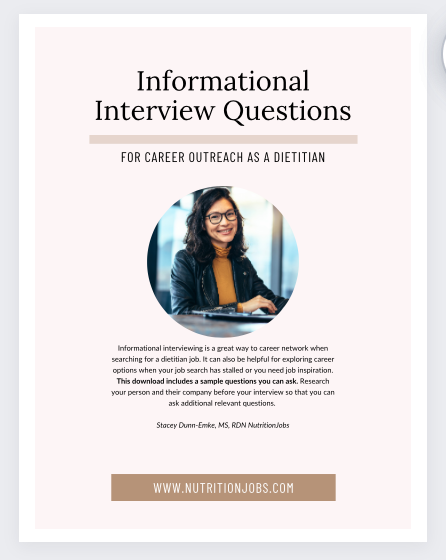
Informational interviewing is one of the best ways for career development and to career network when job searching for a dietitian job or a specific company. It can also be helpful for exploring career options when your job search has stalled or you need job inspiration.
This article gives you an overview to inspire you to schedule an informational interview today! I will show you how to navigate informational interviews, what questions you can ask (and which ones to avoid).
Grab your list of questions here.
Get your complete Informational Interview Guide for Dietitians here.
What is an informational interview?
Let's start at the top. You probably have heard about informational interviews, but I'll share the full scoop.
An informational interview is an informal conversation with someone in or out of your professional network. It is a type of interview where can you can explore a particular career path in dietetics or seek dietetic career advice, with another dietetics professional who has experience or expertise in the field you might be interested in.
The purpose of an informational interview is not to seek employment, but rather to gather information, understand their typical day, job insights, and advice about a specific career, industry, or organization. This can be great for established dietitians or dietetic students and interns. In fact, I often schedule informational interviews with fellow dietitians so I can learn what others are doing with their degree in dietetics (which I pass along to you).
Get your complete Informational Interview Guide for Dietitians here.
What happens during an informational interview?
During the informational interview, you would typically ask questions to learn more about the interviewee's career path, job responsibilities, challenges, and the skills and qualifications required for success in that area of focus.
It's an opportunity to gain a better understanding of the industry, the company, make valuable connections, and receive guidance on how to navigate your own career aspirations.
Informational interviews are a valuable networking and research tool, helping individuals make informed decisions about their career paths, build professional relationships, and uncover hidden job opportunities. They can be especially beneficial for students, recent graduates, or those looking to make a career change by providing real-world insights and advice from experienced professionals.
What are the do's and don't of informational interviews?
Here are some do's when it comes to informational interviews:
- Research the Interviewee: Take the time to learn about the dietitian you'll be interviewing, in addition to the company. Understand their background, career path, and expertise, so you can ask informed questions. Locate their contact information. Research similar job descriptions. Research their specific company too - you can do this by reviewing the company website.
- Prepare Questions: Have a list of thoughtful and relevant questions in advance (mostly open-ended questions). This shows your genuine interest and helps guide the conversation. Use the questions in this guide plus others you find.
- Be Punctual: Show respect for the interviewee's time by being on time for the interview or meeting.
- Listen Actively: Pay close attention to the information and insights shared by the dietitian. Take notes if needed to remember key points.
- Ask for Advice: Seek advice on your career goals, educational pursuits, and any challenges you may face. Be open to receiving guidance. Would you be a good fit for a similar job?
- Express Gratitude: Always thank the dietitian for their time and expertise at the end of the interview. A follow-up thank-you email is important.
- Follow Up: If the dietitian offers to connect you with others in the field or suggests further reading or resources, be sure to follow up on these opportunities or any other next step suggested by your person.
And here are some don'ts (it's a small world in the field of dietetics, so keep your connections happy):
- Don't Be Late: Avoid being late for the informational interview. It's important to respect the interviewee's time, whether in-person or virtual.
- Don't Ask for a Job: Remember, this is not a job interview. Don't ask directly for job openings or employment during the informational interview.
- Don't Be Overbearing: While it's essential to have questions prepared, avoid dominating the conversation. Give the interviewee a chance to share their insights. It’s not an interrogation.
- Don't Make Assumptions: Don't assume that all dietitians have the same career path, education, or experiences. Be open to different perspectives and specialties within the field.
- Don't Forget to Follow Up: If the dietitian offers to connect you with others or provides resources, don't forget to follow up on these leads promptly.
- Don't Criticize or Complain: Avoid negative comments about your current educational institution, job, or colleagues. Maintain a positive and professional attitude. But you can complain about dietitian salaries!
- Don't Forget Your Purpose: Remember that the purpose of the interview is to gather information and insights, not to promote yourself or ask for a job.
The benefits of informational interviews
You might be thinking, why should I consider scheduling informational interviews as a dietitian or dietetic student? Well, here are some compelling career reasons why:
1. Networking Powerhouse: Informational interviews are a powerhouse for networking. They provide a unique opportunity to connect with experienced dietitians in your field, gaining insights and advice straight from the source.
2. Career Exploration: If you're not entirely sure which dietetics career path to pursue, informational interviews can be your compass. They allow you to explore a variety of roles, specialties, typical workdays, and industries within the field of dietetics.
3. Insider Knowledge: Imagine having access to the kind of insider knowledge that isn't found in textbooks or job postings. Informational interviews give you just that—real-world insights and experiences that articles can't replicate.
4. Confidence Boost: As a dietetic student or intern, these interviews can boost your confidence and provide a clearer vision of your career trajectory. Knowing what lies ahead can be a game-changer.
5. Building Relationships: Beyond gathering information, informational interviews are about building relationships. These connections can lead to mentorship opportunities, job referrals, and lasting professional friendships.
Get your complete Informational Interview Guide for Dietitians here.
Setting Up Successful Informational Interviews: A Step-by-Step Guide for Dietitians
We know that informational interviews are an invaluable career strategies for dietitians, dietetic interns, and dietetic students to gather insights, build connections, and explore potential career paths. But how do you go about setting up these meetings effectively? I'll walk you through the process step by step:
Get your complete Informational Interview Guide for Dietitians here.
Step 1: Identify Your Goals
Before diving into scheduling informational interviews, it's crucial to clarify your objectives. Are you seeking career advice, exploring specific job roles, researching a company, or expanding your professional network? Understanding your goals will help you identify the right individuals to interview.
Step 2: Create a Target List
Compile a list of professionals in the dietetics field whom you admire or who are working in roles you're interested in. Consider reaching out to dietitians in various sectors such as clinical, community, research, freelance writing, communications, corporate, recipe developing, long-term care, media, influencer, labeling, private practice, different niches within private practice, food industry, and more. Also consider reaching out to someone with an advanced degree, such as a doctorate in education, for their unique insight.
Step 3: Craft a Personalized Message
When reaching out to potential interviewees, write a personalized email message. Introduce yourself, explain your goals for the informational interview, and express your appreciation for their expertise (and time). Be concise and respectful of their time.
Step 4: Utilize LinkedIn and Professional Networks
LinkedIn is a powerful platform for identifying and connecting with professionals in the dietetics field. You can also tap into your dietetic associations, dietetic practice groups, dietitian Facebook groups, and other networking groups to expand your reach and find potential interviewees. If you need help with your LinkedIn profile, check out my courses here.
Step 5: Send Your Requests
Once you've identified individuals you'd like to interview, send your requests. Be polite, professional, and specific about your intentions. Mention your shared interests or connections, if any, to establish common ground. See sample script in The Informational Interview Guide.
Step 6: Prepare for Rejections and No-Responses
Not everyone you reach out to will be available or willing to participate in informational interviews. Prepare for rejections and no-responses, and don't be discouraged. It's all part of the process.
Step 7: Schedule the Interview
Once someone agrees to an informational interview, propose a few potential meeting times, making it as convenient as possible for them. Be flexible and accommodating with their schedule and their preference for in-person or virtual. Confirm if it will be a face to face meeting, a phone call, or a virtual video meeting.
Step 8: Prepare Thoughtful Questions
Before the interview, prepare a list of thoughtful questions that align with your goals. Ask about their career journey, challenges, advice for newcomers, and trends in the field. Avoid asking questions that can be easily answered with a Google search or LinkedIn search. Grab your list of questions here.
Step 9: Conduct the Interview
During the interview, be attentive, respectful, and curious. Listen actively and take notes. Remember, it's an opportunity to learn from their experiences and insights, and not an interrogation.
Step 10: Express Gratitude and Follow Up
After the interview, send a thank you note expressing your appreciation for their time and guidance. You can just reply back to your original request email so that the communication thread stays connected. If they offered further connections or resources, follow up promptly. Your note essentially acknowledges their contribution to your professional development and leaves the door open for future interactions.
Get your complete Informational Interview Guide for Dietitians here.
Sample outreach script
Here's a sample script to send an email or send a LinkedIn message to someone you know that you want to reconnect to learn more about their job. If you want a sample outreach script that you can email, grab it here.
Subject: Catching Up and Seeking Insights
Hello [Recipient's Name],
It's been a while since we last connected, and I've always admired your expertise in the field. I'm currently at a stage where I could use some guidance.
I was wondering if we could catch up and have an informational interview? Your insights on [specific topics or areas you'd like to discuss, e.g., recent developments in our field, career advice] would be immensely valuable to me.
I truly value your opinion, and your experiences can help me make informed decisions as I progress in my dietetics journey. I'm flexible with the timing and can adapt to your schedule and can meet in person or virtually.
I'm looking forward to reconnecting.
Best regards, [Your Name]
Types of specific questions you can ask
Here are a few questions you can ask your person:
1. Can you tell me about your career path and what led you to the role you are in today?
2. What skills do you think are most important for someone interested in a job like yours?
3. What skills did you need to develop to succeed in this job?
4. Was there a previous job you had that really prepared you for this type of job?
5. What do you find most rewarding about your job?
6. Can you share your typical day-in-the-work-life?
7. What are some notable projects or accomplishments you’ve had in this job?
8. What are some of the biggest challenges you face day-to-day?
9. What opportunities for career advancement exist in your focus area? Are there specialized certifications or further education paths to consider?
10. Where do you see yourself in 5 to 10 years from now professionally?
Grab your workbook of questions here.
Get your complete Informational Interview Guide for Dietitians here.
Takeaways
Informational interviewing are the best for career development and to career network as a dietitian or dietetic student or intern. Now that you have all the tools you need to succeed get out there and learn from others in the field. Have fun with it! Tell me how it goes. - Stacey
