
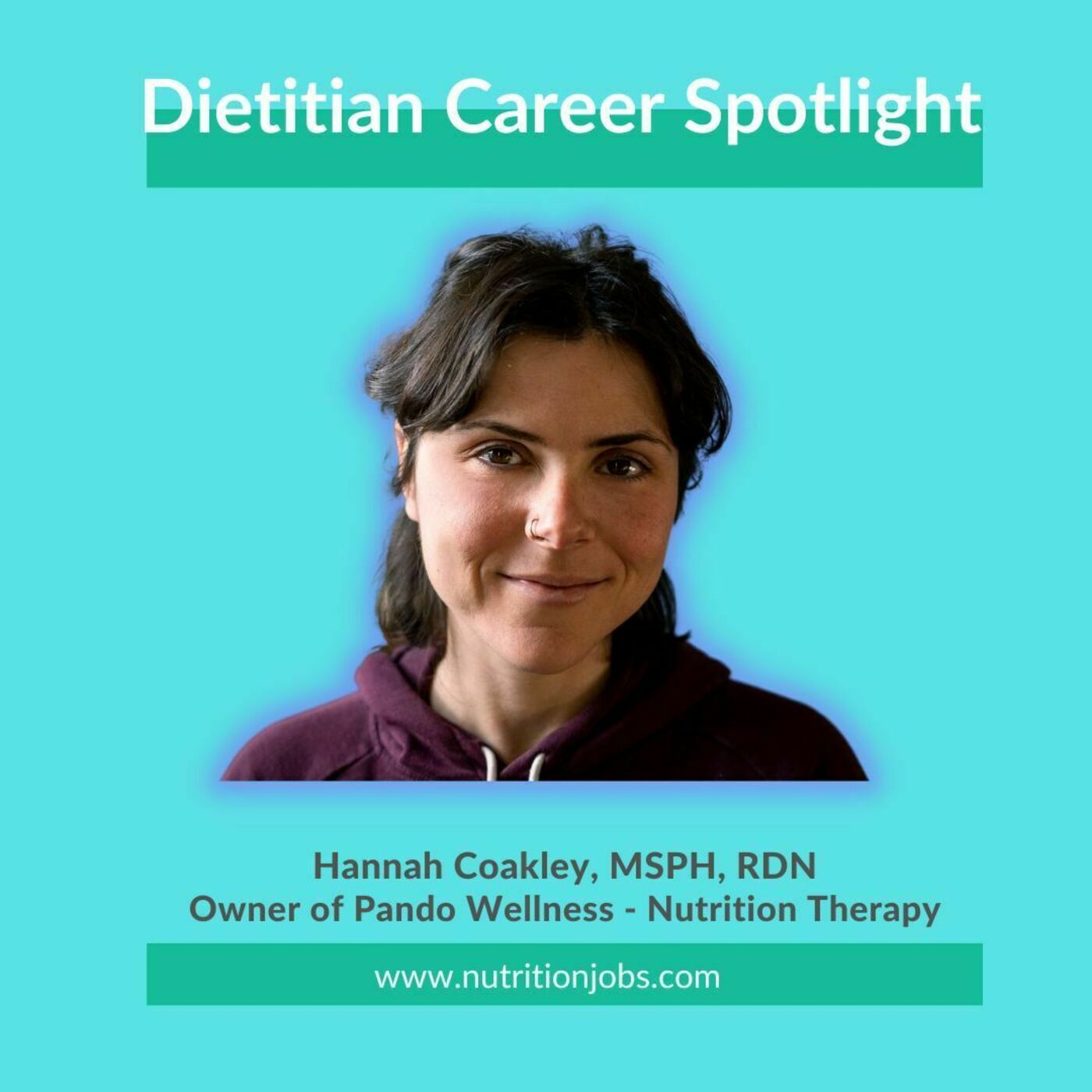
Dietetic Career Spotlight on Hannah Coakley, MSPH, RDN, Owner of Pando Wellness
Meet Hannah Coakley (they/them), the founder and owner of Pando Wellness. Hannah is a queer, non-binary RDN (Registered Dietitian Nutritionist) with extensive experience in individual counseling, food justice & body image programming, as well as specialized expertise in treatment of clients recovering from eating disorders. Read about how Hannah’s experiences lead them to create a business centered around helping others improve their relationship with food - Katie
What attracted you to the field of nutrition and dietetics?
I began my undergrad studying urban planning - how cities develop & operate. I studied abroad and saw how essential nutrition is at a population level, so at first I was sure I'd be working internationally in nutrition & health.
After a more critical discernment of whether my role in another country was appropriate, I pivoted to domestic food justice & food access. I loved that path, but also felt like I wasn't able to weave together the threads of activism & psychology as much as I wanted at a programmatic level.
I took many detours, but I finally have landed in a place where I can engage with psychology, behavior, activism & healing all at once.
So, for me, the most interesting parts of nutrition are actually mostly to do with how food is communal, emotional, embodied, ancestral & political - and much less to do with the food itself!
Company you are with now?
My own! Pando Wellness
Your Job Title?
Owner of Pando Wellness - Nutrition Therapy
Website:
Social Media:
https://www.linkedin.com/in/hannah-coakley-rdn/
A typical (or not so typical) day-in-the-work-life for you?
Most workdays I go for a 15ish minute mindful walk in the morning without my phone or any other distraction, then I usually come back for breakfast, review client logs & start my day's sessions.
My sessions run 45 - 50 minutes, so I have time in between to get water, send any resources we've discussed or to simply breathe. I do this for 4 hours or so.
Then I usually take a break for lunch & to run an errand, do some "business maintenance" items like send emails, post on social media, etc... or move my body in some way.
I then have my second set of clients in the afternoon/early evening. Then I'll end the day by sending whatever emails are left, scheduling intro calls for new clients & just general life preparation. I try to complete any small tasks (that would take less than 10 minutes to complete) by the end of each day, which helps my stress level enormously.
I leave my worknight evenings free for talking to friends, reading books, playing games or watching movies with my partner - and I don't take my phone into the bedroom usually, which helps too :)
How did you get your current job in dietetics?
This answer is a bit of a winding road! After working in public health nutrition for several years, I had a major reckoning with myself. This led to a decision to leave my job, my apartment, all of my friends and move to a Zen Buddhist monastery in New Mexico. What began as a 3 month desire to have some time to focus/meditate became a 16 month commitment to an entirely new way of being.
Towards the end of my stay, I was approached by an eating disorder treatment center in Memphis, asking if I was interested in joining their team. Their therapeutic modality was heavily influenced by Zen Buddhism, so my background was of particular interest to them. I worked at that treatment center as their Outpatient Nutrition Director for about a year - where I was given intense training and quite a lot of direct client contact hours.
After leaving that position, I went on to do a few other things (farming being the main one), but I realized that I deeply missed working in ED recovery. Once the pandemic began and my original plans for 2020 became moot, I decided to start my own virtual private practice - with an emphasis on sliding scale/affordable services for clientele for whom access to competent care is often challenging: Queer, TGNC & BIPOC folks. As a Queer, non-binary person, this was very important to me.
In May of this year, I was able to leave my part time telehealth work that I had taken on to supplement income while I grew the business. I'm now currently able to support myself full time in my practice & have begun offering case consultation to RDs who would like to grow competency in serving LGBTQIA+ & Trans/gender non-conforming clients.
What skills were you born with and what skills have you learned along the way?
I think the skills I was born with are curiosity, compassion, a strong sense of humor & desire to make others laugh, risk-taking & a genuine love of people.
The skills I've learned are longer - organization, setting boundaries, practicing compassion for myself, asking for help, listening without an agenda, trusting others to be able to access their own wisdom vs trying to 'fix' them, patience, addressing & holding myself accountable for my own biases/harmful behaviors, managing my reserves of energy, skillfully incorporating suggestions for improvement.
What advice do you have for others wanting to be just as successful and fulfilled as you?
I tend to gravitate towards paths/jobs/experiences that hold deep curiosity for me, rather than what was expected or seemed like a practical choice at the time.
Taking jobs on farms and as a monastic entirely living on donations, helped me to also adapt my lifestyle to one where I can prioritize time & flexibility over money. Not everyone has the privilege to contemplate money in this way, but I find that being able to live with less frees up tremendous mental & emotional space.
I've also found that moving towards things that bring me deep joy & fulfillment, as well as things that align with my ethical views, even when they are really heartbreaking or challenging, is pretty much my guiding principle. Moving towards joy. Being comfortable with myself & my mind helps to make that awareness clearer.
I have hard days, too. But I feel extremely lucky that I've found a calling & not just a job - and I think that's due to all the jobs that came before, places I've lived & ways I've needed to adapt, survive and move towards thriving.
If you could be paid for your job with something other than a paycheck, what would it be?
Ooh! I'd say airline miles & camping/hiking equipment :)
About the Author
Katie Padva, MS, RDN, LDN, is a Registered Dietitian passionate about delivering nutrition education through writing, teaching, and counseling to help prevent and manage chronic diseases. She works in a private practice helping individuals be the best version of theirselves through healthy nutrition. She also works as an adjunct instructor at a University educating students on nutrition concepts. When she is not working, Katie enjoys being outside, running, writing, cooking, doing yoga and hiking! Connect with her on LinkedIn.
