
Dietitian Leadership Skills

One of the most frequent questions I get asked is how one can show leadership skills on a resume. That is such a good question because if you have been through any course, webinar, or workshop with me, you will know that the golden ticket on your resume is demonstrating professional leadership skills.
Having valued skills, like leadership skills, on your resume and demonstrated with your performance on the job, leads to higher pay.
This article will cover all the important elements of how to highlight your leadership skills as a dietitian and why it matters.
Related: Download the Leadership Skills Action Verbs Guide
Why leadership skills matter for your career
You might know that leadership skills are supposedly important to include on a resume, but you might also be thinking, "Exactly why are leadership skills so important, anyway?" Good question! In addition to higher pay with more leadership skills, here's why leadership skills in the workforce matter:
- Broadens your experience - Being in the position of leading or leadership, gives you greater experience. For example, you might be tasked with evaluating the enteral nutrition formulary in a clinical setting. This might be a new project for you, one that you haven't done previously. You will need to make a plan for completing this project and communicating the summary of your evaluation. You might gain additional skills while tacking this project, like creating spreadsheets, or communicating your needs with Sales Representatives. This project broadened your skills and your experience, specifically your leadership skills.
- Boosts your confidence - Taking a leadership role inherently pushes you, which is such a confidence booster (in the end!). This is true especially when having to speak in front of an audience at a committee meeting or in a room full of managers listening to your committee report.
- Hones your Strategic Thinking Skills - While strategic thinking skills alone is powerful leadership skills, just the process of leading can push your creativity when tackling a project. Most projects take some unexpected turn along the way, that requires some creative problem solving and strategy involved.
- Multidisciplinary Interaction - Most leadership endeavors involve working with or managing other people, which gives you the chance to interact with more professionals.
- People Can Count on You - This might seem obvious, but having demonstrated leadership skills is valuable for managers and people you report to. It shows them that you can handle situations and people without a lot of handholding or micro-management. It means you can be trusted to complete a project successfully. For a manager, that is incredibly valuable.
Related: Download the Leadership Skills Action Verbs Guide
Examples of leadership skills at work
There are many different types of leadership skills required in the workplace. The most in-demand include:
-
Empathy - Understanding the needs of others is crucial to leading. Leading is about understanding the perspective of the customer, the employees, the upper management, vendors, collaborators, and more. Being empathetic as a leader puts you in the position of making positive changes where everyone benefits
-
Positivity - This can go a long way in an office setting. Positivity can create a happy, creative, and healthy work environment, even during busy, stressful periods
- Strategic thinking
- Trustworthiness - People need to be able to feel comfortable coming to you with questions, clarification, and concerns. It is important for you to demonstrate your integrity because people will only trust leaders they respect. By being open and honest, you will encourage the same level of trustworthiness in people around you.
- Creativity and Strategic thinking - You will probably need to make a number of decisions that do not have a clear path or an obvious answer; you will need to be able to think outside of the box ... a lot! Learning to try nontraditional solutions, getting input from people or employees around you, or approaching problems in nontraditional ways, will help you to solve an otherwise unsolvable problem.
- Flexibility - Not everything goes as planned, or people go as planned!
- Good communicator - Good written and verbal communication is key to any successful project or manager. Miscommunication can be problematic for so many reasons.
- Confidence - The ability to speak up with confidence is important with any leader. To speak with confidence helps set a clear path.
- Cheerleader - Boosting people around you and helping others under you get promoted is the sign of a strong leader.
- Emotional Intelligence - This is similar to being empathetic. Understanding the room, understanding your client, or understanding the needs of your employees is invaluable.
- The Amazon company publishes its Leadership Principles to be used as a guide during the hiring process and other decision-making processes. Their Principles include, Leaders are Owners, Learn and be Curious, Insist on the Highest Standards, Earn Trust, Deliver Results, and more.
Leadership Skills as Core Competencies: Navigating Personal and Professional Growth
Leadership isn't just about spearheading projects; it's about fostering growth, understanding, and respect. Leadership competencies that can make a difference in any professional journey.
-
Self-Assessment for Growth - Assess your learning, leadership styles, and cultural orientation to pinpoint strengths and areas for growth. Set clear self-improvement goals to ensure continued development.
-
Articulate Your Strengths - Recognize and communicate your skills, strengths, and experiences. Aligning these with your career aspirations ensures you're a vital asset to any team.
-
Advocate for Yourself - Taking the initiative, whether it's seeking responsibilities, negotiating salaries, or pushing for promotions, can unveil hidden opportunities.
-
Resolve Conflicts Efficiently - Efficient conflict resolution cultivates understanding and respect, ensuring smooth operations within teams.
-
Promote Team Diversity - Recognizing each member's unique skills fosters innovation. Celebrating diverse skills and perspectives leads to comprehensive solutions.
Be a Beacon: Mentor Others - Leadership is as much about guiding others as it is about personal growth. By mentoring other dietitians, leaders can share their knowledge, provide valuable insights, and foster the next generation of leadership. This cycle of mentorship ensures that skills and knowledge are continuously passed on.
Championing the Value of Precepting Dietetic Students - Guiding dietetic students and interns not only enriches the future of the profession but also provides leaders with fresh perspectives and renewed enthusiasm for their own roles.
How to add leadership skills to your resume so that hiring managers call you in for an interview
Highlighting your leadership skills on your resume can actually help you stand out and get called back for a job interview. It can increase your opportunities.
Leadership experience can be formal, such as the job title of Manager. Or it can be demonstrated in the projects you led or the people you helped mentor.
Here's how you can add leadership skills to your resume so that you get called in for a job interview.
1. Projects you led. Add any projects that you chaired or co-chaired to your work experience section. Even if you are a new grad, add them. It shows that you can take a project from beginning to end. That's leadership.
2. Mentorship. Did you take on a new student or a new employee for training? Add to show that you can lead people. Employers love that you can lead people and foster a happy work environment.
3. Leadership action verbs: Start your work success bullet point with an action verb, such as: executed, resolved, orchestrated, spearheaded, led, managed, implemented. Ask ChatGPT to help too.
4. Decision-making examples: Did you select the enteral formulary? Did you update the malnutrition risk assessment tool. Did you hire a virtual assistant? Decisions are all a part of leadership skills. Highlight in work experience section.
5. Leadership training. I've mentioned already but having didactic and practical training in leadership is everything. Include leadership certifications or trainings in either a dedicated section or in your education section.
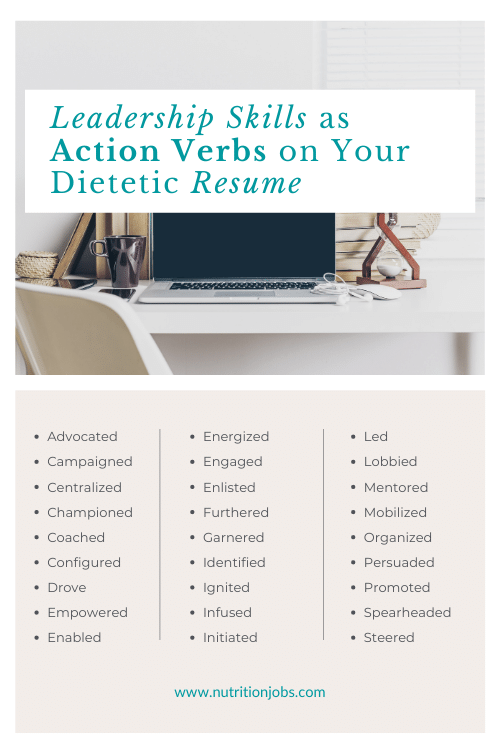
Examples of leadership skills as action verbs on your dietetic resume
If you've ever taken a course, a webinar, or a workshop from me, you will know how I emphasize Quantifiable Work Success bullet points on your work experience section, beginning with action verbs. Here's a list of such action verbs that denote leadership traits on your dietetic resume.
Related: Download the Leadership Skills Action Verbs Guide
How to Create Leadership Opportunities
There are lots of ways to cultivate leadership skills as a dietitian. Here's a brainstorming list of ideas.
- Volunteer Committee Membership
- Serve on a Dietetic Practice Group committee or board
- Serve on a committee or the board of a dietetic local, state, or national professional association
- Mentoring students or other dietitians
- Committee chair or member in the workplace
- Workshop Host
- American Academy of Nutrition and Dietetics Leadership Institute
How to Get Leadership Skills
Now that we know that we need leadership on our resume, here are some tips on how to get leadership skills. I asked Shawnee M. Kelly, MS, RDN, LDN, Assistant Teaching Professor & Coordinator, Masters in Professional Studies (MPS) in Nutritional Sciences at Penn State University, for her favorite tips for students and dietitians.
Shawnee M. Kelly, MS, RDN, LDN:
- Leadership is about confidence. We want our students to be able to feel confident to speak up when they get out into the workforce right out of the graduate degree; to feel confident to speak up for change.
- Leadership can just be advocating for a small policy change when sitting on a committee. When asked, say yes to committees, like Quality Improvement Committees.
- Leadership can come in so many forms, with or without power or authority
- Leadership helps you develop the soft skills, communication skills, written skills, oral skills, when you speak professionally.
- Having empathy for others is a strong leadership trait.
- Our curriculum in the Masters in Professional Studies (MPS) in Nutritional Sciences at Penn State University, does have a leadership emphasis, starting with an introduction leadership course, and then a more advanced one later in the program. All of our courses integrate themes of leadership throughout.
- Our mission is to advance the practice of leadership and to give students the skills to do that; whether it be clinical or outpatient counseling, or nutrition education.
- The first leadership course is learning about yourself as a leader. We do a lot with the strength finder assessment tools, like Myers Briggs, learning how to do a SWOT analysis. And then we put that into the context of the nutrition and dietetics profession.
- We want the students to experience confidence in the program, and know themselves as a leader. They may not be the most experienced leader right out of graduate school, but they know themselves more as a leader and can build on it from there.
Related Articles
How to Get Good Letters of Recommendation
Dietitian Collaborations to Boost Your Career
About the Author
Stacey Dunn-Emke, MS, RDN, is the Founder Owner of NutritionJobs and an established dietetic career expert. She helps steer dietetic and nutrition professionals to a successful job search process with the top-ranked dietetic job board platform, NUTRITIONJOBS. Stacey is the author of The Dietetic Resume Guide and numerous dietetic career action-ables. She gives the tools to create a modern standout dietetic resume to land that job interview, help with job interview prep, and with creating All-Star LinkedIn profiles. Stacey has interviewed and hired many dietitians and in running NutritionJobs since 2000, she has reviewed thousands of dietetic resumes. She works closely with dietetic hiring managers and recruiters to know what standout resume elements land a job interview.
